
How to Build a 2027 HR Budget You Can Defend


In this article, we'll explore:

Each fall, many finance teams build next year's budget, and people costs are among the largest expenses they encounter. Payroll, benefits, workers’ compensation, business insurance, compliance, and the time your HR and finance staff spend managing them all count toward that total, and these costs change for different reasons. To keep the process manageable, many teams take this year's HR total and add a percentage increase. That copy-forward budget approach works for costs that follow a known schedule, and that’s why HR budgets often break.
On the surface, a copy-forward budget makes sense. Payroll tax rates and the taxable wage base are published before the year starts, and merit increases follow a plan the company sets. Even workers' compensation and unemployment insurance rates, which can change after injury claims or layoffs, are based on prior years, so the new rate is rarely a surprise.
But other HR costs are harder to forecast. The health insurance renewal is the clearest example. If your plan is priced on your own claims, the renewal depends on how much your employees used their coverage. Most companies that renew benefits on Jan. 1 receive renewal pricing 60 to 90 days prior, which can fall after the budget is due. Compliance costs can also change during the year, and staff time spent on administration never shows up on an invoice.
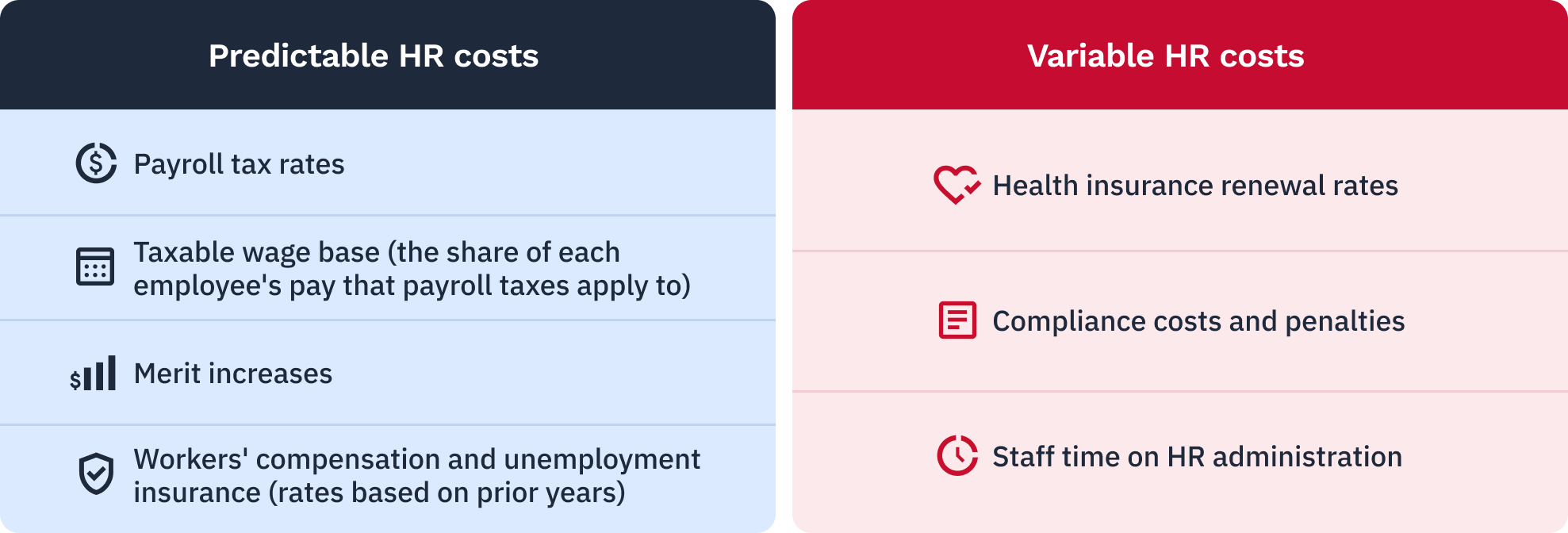
When these costs come in higher than the copy-forward number, the difference may have to come from initiatives the company already funded, such as a new hire or an expansion into another state. Building the budget from this year’s numbers, one cost at a time, shows where each figure comes from before that happens. It also shows what your current HR setup really costs, which is the number you need if you ever want to check whether a different way of handling HR, such as outsourcing some or all of it, would fit your company better.
Whether your 2027 budget is in progress or already submitted, here's what to know before you finalize or update it during the year.
The five steps below walk through how to build that budget and, if you're considering outsourcing some or all of your HR, how to compare your options task by task.
Step 1: Add up your full current HR cost
Most HR budgets are built from vendor invoices, and invoices cover only part of what HR costs. Consider a 90-employee manufacturing company in Ohio, all full-time, with a two-person HR team. Those invoices make up one of three parts of its full HR cost. We’ll use this company as an example along the way.
Each part comes from a different source, so pull them separately.
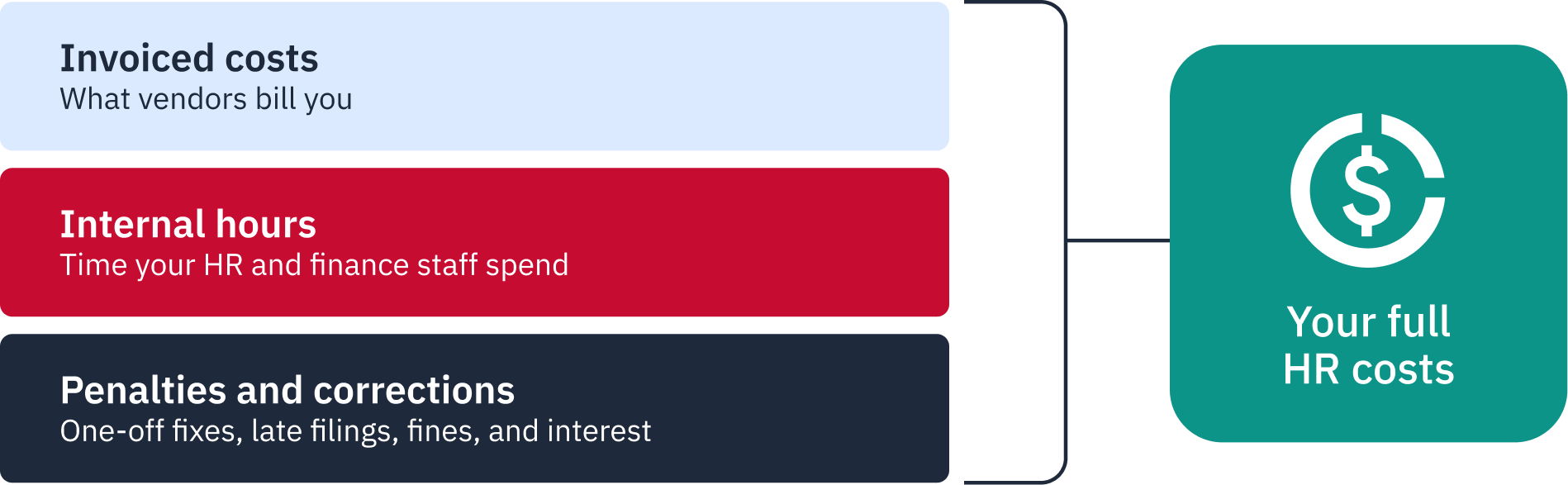
- Invoiced costs.
These include items such as payroll processing, benefits premiums and the employer contributions, workers' compensation, retirement plan administration, human resources information system (HRIS) or human capital management (HCM) software, employment practices liability insurance (EPLI), ACA filing, background checks, and training and compliance tools.
Pull 12 months of actual spending and compare it with what you budgeted to see how accurate last year's assumptions were. - Internal hours.
HR and finance staff spend time on payroll, benefits enrollment, error correction, vendor coordination, reporting, and employee questions. Estimate the cost as the number of people × the share of their time × a fully loaded hourly rate (pay plus payroll taxes and benefits).
Count benefits administration separately because it peaks around open enrollment and year-end reporting. - Penalties, fines, and corrections.
Off-cycle payroll runs, late or amended filings with interest, wage-and-hour violations, and tax penalties show up as one-off charges. Pull 12 months of history.
If the two-year total is more than zero, budget for it every year. If the same correction shows up more than once, review how it was missed so it doesn’t happen again.
Adding up all three parts gives your finance team a baseline. It also shows where your HR and finance team’s time goes. The Ohio company's finance team documents what the two HR employees are working on today and what they would work on with more time, such as workforce planning, retention strategy development, compensation benchmarking, and learning and development. If headcount approaches 130, the company should also consider hiring a third HR employee.
The 2027 HR cost worksheet brings all three parts into one total, with a notes column for who owns each expense. Fill it in with your 12 months of actuals before you move on to Step 2.

Download the 2027 HR Cost Worksheet
Step 2: Model the benefits renewal in three cases
With this year's baseline in place, turn to the cost most likely to change from year to year: the benefits renewal. When a plan is priced on your own claims, the price depends on how your employees used their coverage. Applying a single percentage increase to next year’s budget is usually a guess.
Instead of applying one percentage, build the estimate from what drives the renewal. Six inputs determine how much it changes, and you can estimate each one separately. Then combine them, because every input feeds the same renewal number in your budget.
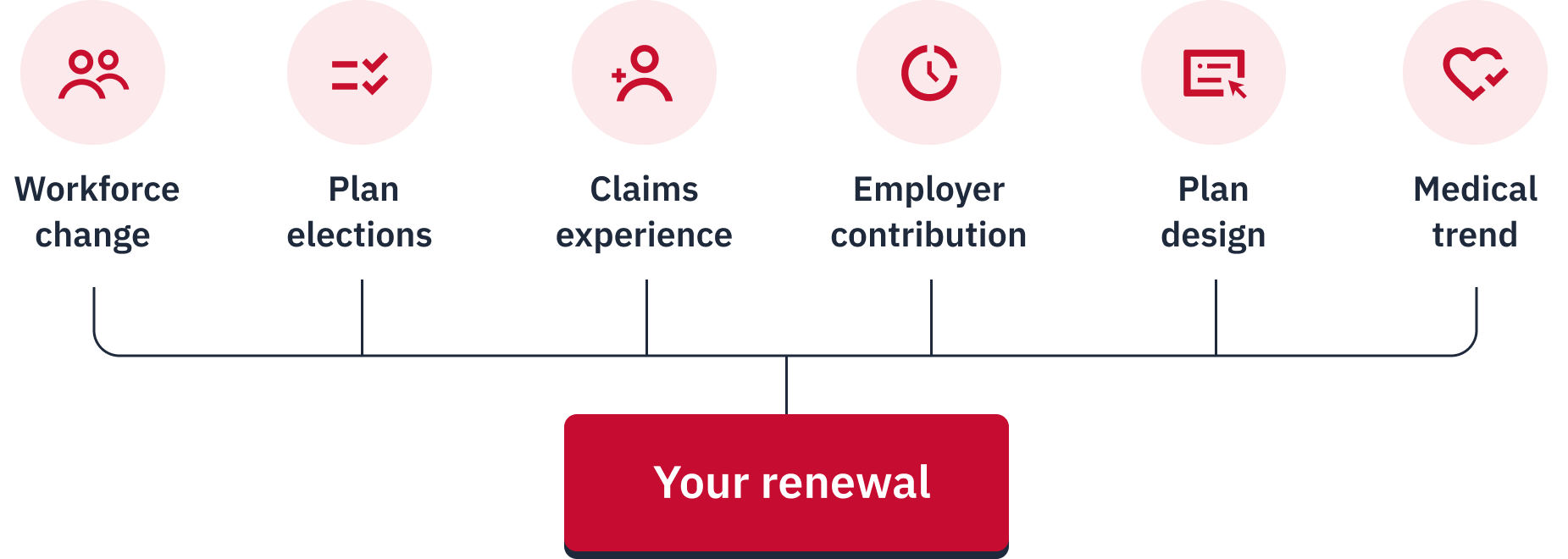
Your broker, your carrier, and your own claims history can give you a realistic range for each input. Combine those estimates into three cases:
- Baseline case. Uses the increase you expect.
- Conservative case. Assumes a higher increase than you expect, and it’s the number you submit so the budget has room if the renewal comes in high.
- Stress case. Tests a bad year, such as a high-dollar claim, so you know how far over budget the renewal could run.
When the actual renewal arrives, compare it with each case to see which input shifted.
Claims experience can raise a renewal quickly. A single high-dollar claim, such as an organ transplant, a stay in a neonatal intensive care unit (NICU), or a long-term specialty drug, can raise a renewal on its own. How much it raises the renewal depends on how many people share that cost in the group your plan is priced on. The more people in that group, the smaller the effect of any one claim.
The Ohio company’s plan, for example, is priced on its 90 employees, so one high-dollar claim is spread across 90 people. A 200-employee company is still a small group for a claim that size, so it can see the same jump. In a professional employer organization (PEO), a master plan prices coverage across a much larger and more diverse group of employees from many companies, so the same claim is spread across far more people.
Whichever way your plan is priced, the assumptions behind a renewal quote shape the number that goes into your model. Every initial benefits quote is built on assumptions about claims and about medical trends, meaning how fast health care costs are expected to rise. As you review your renewal quote, send these questions in writing to your current provider and any provider you're evaluating:
- What medical trend and claims assumptions produced the year-one number?
- Is my account priced on my company's claims history or on a pooled population, and are the year-two and year-three estimates based on the same thing?
- If a master plan pool is an option, what are the eligibility requirements, and how is my risk profile assessed?
- Which variables does the provider control?
Use the answers to adjust your three cases before you add the conservative case to your budget.
Step 3: Assign each compliance requirement to a role
Compliance costs can change during the year too. Federal and state rules set filing deadlines, tax rates, and required notices. Each one takes staff time to handle correctly. When something is filed late or incorrectly, fixing it takes more time and money, and a penalty, fine, or legal claim may follow.
These costs are easier to control when each requirement is assigned to a role instead of a person, so responsibility stays with the position as people change jobs within the company or leave. As you review your costs, you may find some requirements lack a clear owner. For each one, write down the responsible role, how often it's due, which roles are notified of errors or corrections, and which records to keep. Two federal requirements, health coverage reporting and federal unemployment tax, show how quickly the costs can add up.
Health coverage reporting
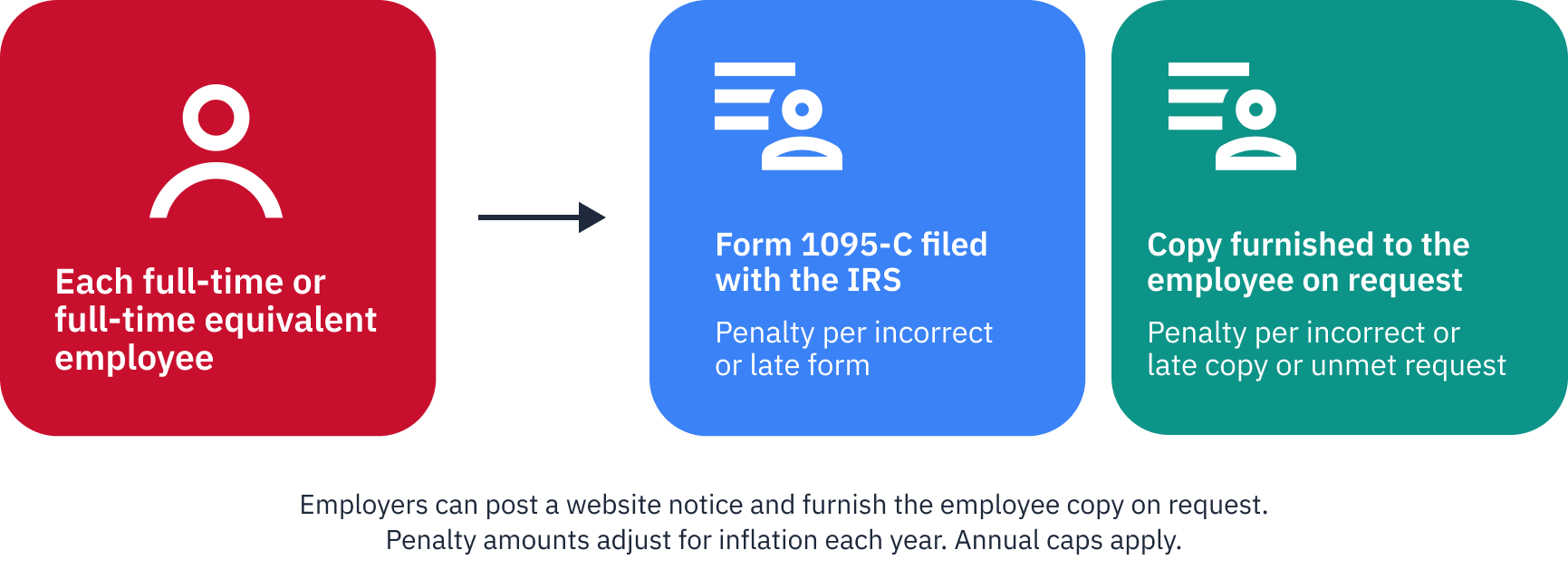
Under the Affordable Care Act (ACA), employers with 50 or more full-time or full-time equivalent employees must file two IRS forms each year: Form 1094-C and Form 1095-C. These forms show that the employer offered health coverage. The IRS can assess a penalty for each incorrect or late Form 1095-C filed with the IRS and, when an employee copy is required, a second penalty for each incorrect or late copy. Employers can now post a notice and furnish the employee copy on request instead of sending it automatically, so the second penalty mainly applies to employers that furnish automatically or don't honor a request (IRS Instructions for Forms 1094-C and 1095-C).
For tax year 2026 returns, which are due in 2027, the penalty is $340 per return and $340 per statement for most failures. It drops to $60 if the error is corrected within 30 days, and annual caps limit the total. These amounts adjust for inflation each year, so check the IRS information return penalties page for the year your returns are due. Because all 90 of the Ohio company's employees are full-time, one bad filing year could bring up to 180 penalties: one per return and one per employee statement, or $61,200 at the $340 rate before any cap applies.
Federal and state unemployment tax
The Federal Unemployment Tax Act (FUTA) requires employers to pay 6.0% on the first $7,000 of each employee's wages, with a credit of up to 5.4% (IRS Topic no. 759). The FUTA rate is the same nationwide, but it changes when your state has an unpaid federal loan (called a Title XII loan) used to pay unemployment benefits. In that case, the credit shrinks, and employers in that state pay more federal unemployment tax.
Your state unemployment tax (SUTA) rate works differently. It's unique to your business and is based on factors such as your industry and layoff history. Check the Department of Labor's FUTA credit reduction list each November, and assign a role at your company, such as your payroll manager or controller, to track your SUTA rate change each January.
Other requirements
Beyond these two, other requirements depend on your state and your workforce.
- Worker classification under wage-and-hour rules
- State disability and paid-leave programs
- State retirement plan mandates
- Required notices and posters
- Wage rules in each state where you have employees
- New York and California are two of the states with added requirements. List each requirement in your worksheet and note the role responsible for it.
Step 4: Compare HR services options task by task
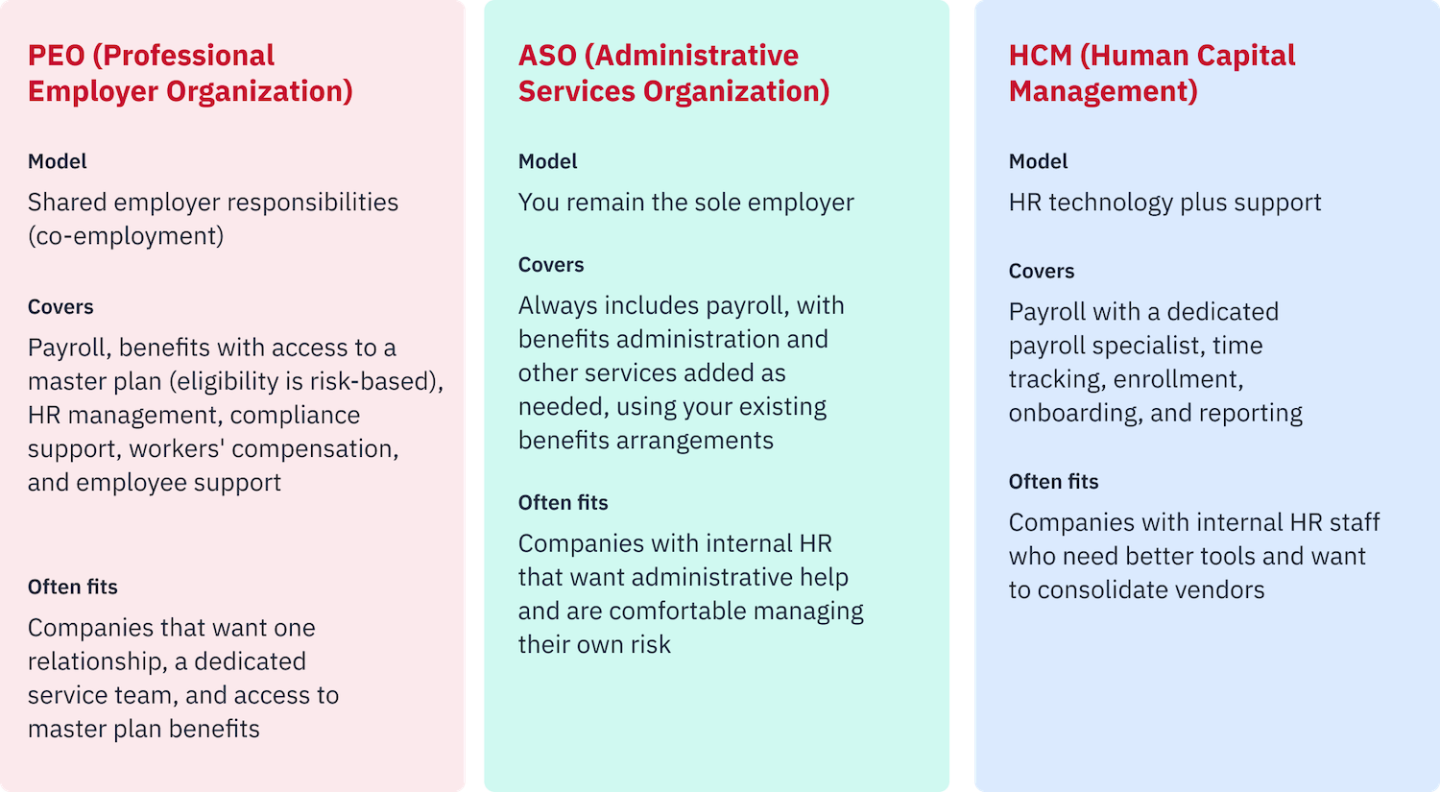
If the baseline from Step 1 raised questions about whether your current HR setup works, use the numbers from Steps 1 through 3 to compare it with other ways to manage HR. Three common alternatives are a PEO, an administrative services organization (ASO), or a human capital management (HCM) platform. They differ in which tasks the provider handles and which ones your team keeps, and how the services are delivered. A PEO, for example, becomes a co-employer of your employees, while an ASO or HCM platform provides services without that relationship.
To compare them fairly, check each option against the same list of tasks:
- Payroll
- Benefits administration
- Compliance support
- Workers' compensation
- Technology
- Employee support
- Retirement plan administration
Next to each task, note whether the option covers it, what the provider handles, and what it costs. Your team does any task an option doesn't cover, so add those hours to your model. G&A Partners uses these same tasks in our HR services comparison.
You can also compare these options with hiring. The Bureau of Labor Statistics (BLS) median salary for an HR manager is $149,280 (May 2025). Replace that figure with the salary for the role and location that fit your company.
If you move to a PEO, an ASO, or an HCM platform, your HR headcount may stay the same. What changes is the work your team spends time on. For example, hours spent on payroll corrections and benefits paperwork could instead be allocated to workforce planning or retention strategies. Model that outcome too, with the same headcount and different hours for each task.
Switching to a new HR setup also adds one-time costs to the first year that later years won’t have. These can include implementation fees, data gathering, payroll validation, and any period when you pay two vendors at once. Add those costs to the first year of each option you're considering, separate from its ongoing cost.
Step 5: Count back from your deadlines
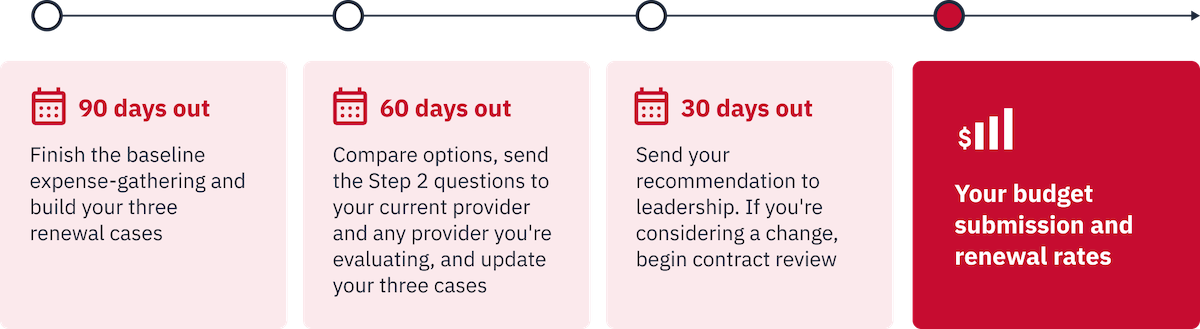
This last step turns all this work into a schedule built around your budget submission date and your benefits renewal date. Count back from whichever comes first, and set these milestones:
- 90 days out: Finish the baseline and build your three renewal cases.
- 60 days out: Compare your HR services and benefits, send the Step 2 questions (claim assumptions, master plan, estimates, etc.) to your current provider and any provider you’re evaluating, and update your three cases with the answers.
- 30 days out: Send your budget recommendation, including your three renewal cases and any change you’re proposing, to leadership. If you’re considering a change, begin contract review.
If you have less than 90 days before your renewal, focus on the baseline and the Step 2 questions now. Save the full schedule for your next renewal or a midyear budget update.
If you plan to change providers at your renewal date, leave time for implementation after the contract is signed. A G&A PEO or ASO implementation typically takes six to seven weeks, and an HCM implementation takes about 30 days. If that window has already passed, plan the change for your next renewal by setting your 90-, 60-, and 30-day milestones, and share them with the roles responsible for each.
Bring a number you can explain
These five steps give you a 2027 HR budget built from your own numbers. You'll have a complete picture of what you spend today, three renewal cases, an owner for each compliance requirement, and a task-by-task view of your options. Begin with the worksheet and 12 months of actuals.
If you're comparing options, G&A Partners can help you choose the HR services option that fits, document who handles each task, and plan a transition.
Where to go next
If you're building your 2027 budget now
Download the 2027 HR cost worksheet to add up what you spend today.
If you already work with a PEO and your renewal is coming up
Get the PEO Renewal Readiness Scorecard to evaluate your current provider before your next renewal.
If you're planning a change at renewal
Read the 90-Day PEO Renewal Plan, which maps the provider evaluation, contract decision, and implementation window in the 90 days before your renewal.
If you're weighing a PEO, an ASO, or an HCM platform
Talk to an expert. You can book a time that works for you, and the first conversation begins with a look at your current setup.
*Important Legal Disclaimer: Nothing in this material is intended to be, nor should it be construed as, legal or financial advice. Read more.