


- HR Speak
- SMB Trends
- How is OBBBA Affecting Small Businesses? New Survey Data Has Answers
How is OBBBA Affecting Small Businesses? New Survey Data Has Answers



The One Big Beautiful Bill Act is one of the most consequential pieces of legislation to hit small businesses in recent memory, and if you're a small business owner, you're likely already feeling it in some form.
In this article, we dive into the data from the G&A Partners 2026 SMB Readiness Report to see the impact of OBBBA on small businesses on the ground: What's working, what isn't, and what it means for how you operate, plan, and make decisions going forward.
The Impact of OBBBA on Small Businesses
Depending on your situation, the One Big Beautiful Bill Act may feel like a relief or a burden, and the data suggests you're far from alone either way. It's producing one of the clearest splits in SMB sentiment.
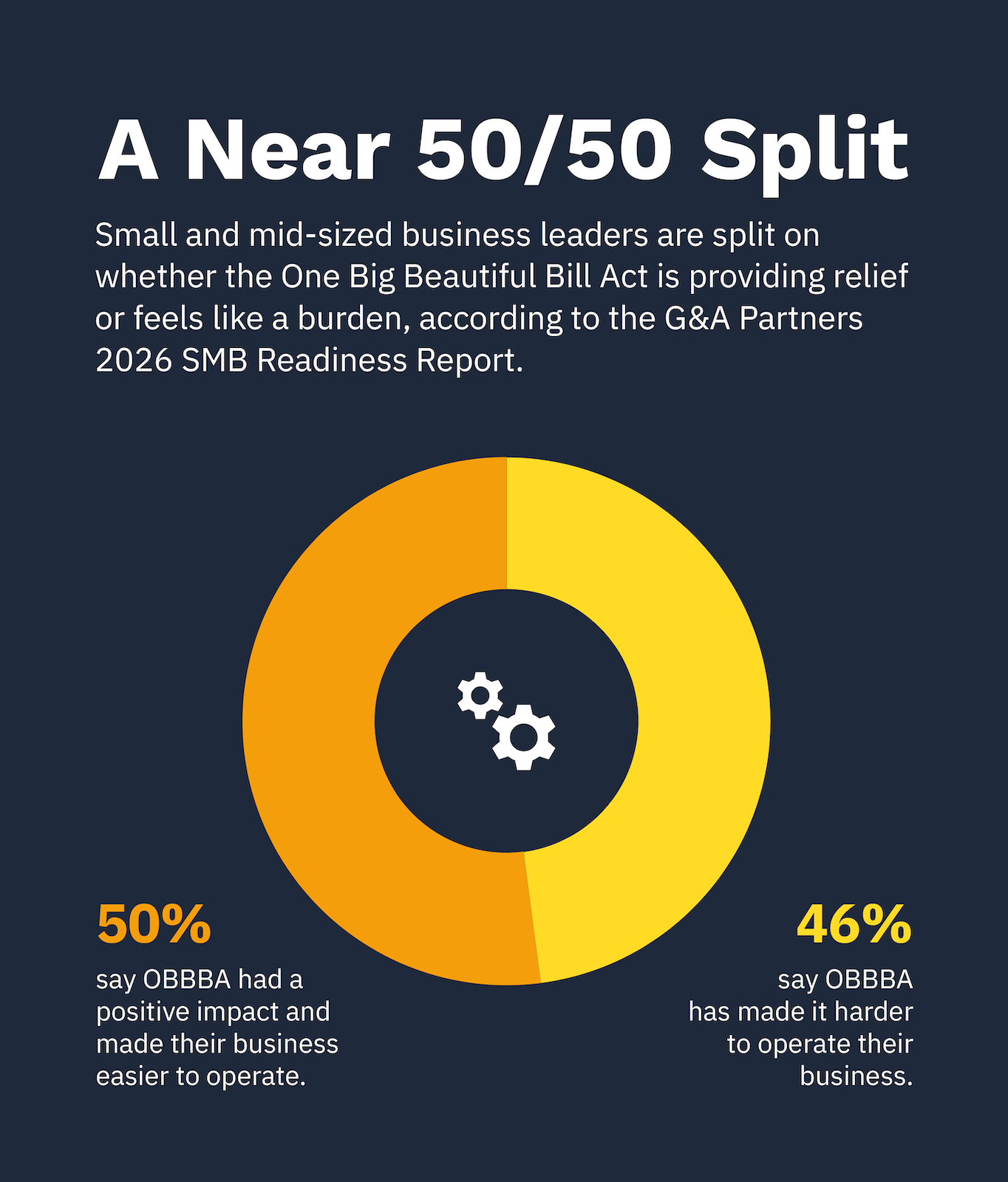
Half of SMB leaders (50%) in the 2026 SMB Readiness Report say OBBBA has had a positive impact on their business, while 46% say it's made things harder. On the surface, that looks like a near draw. Here’s a closer look at what sits underneath both sides of that number.
Where SMBs are feeling relief:
- 54% say gift and estate tax changes make it more likely they'll keep their business in the family
- 50% say it's easier to operate
- 46% say overtime and tipping changes have improved worker morale
- 38% say R&D deduction changes have benefited their business
- 37% say the legislation has helped them expand
Where SMBs are feeling the burden:
- 68% report increased operating costs
- 61% have raised prices, cut expenses, or delayed investments
- 58% are spending more time navigating compliance demands
- 51% say it has prevented them from expanding
- 50% say it's harder to hire
- 49% have delayed key business decisions due to uncertainty or complexity
- 46% say it has made it harder to operate
- 22% have considered selling their business or portions of it
Behind the Split: What’s Really Driving Small Business Sentiment on OBBBA
No matter where you fall on the OBBBA split, there's a layer beneath these numbers that tells a more complete story about how the legislation is impacting small businesses.
Positive sentiment doesn't equal operational ease
A sizable share of SMBs who feel positively about OBBBA are also reporting increased costs, compliance burdens, and delayed decisions, and that’s not necessarily a contradiction. Adjusting to a law this broad takes time, regardless of how a business owner ultimately feels about it. An SMB leader can see long-term value in the legislation for their business, yet still find its day-to-day requirements difficult to manage right now.
The cost impact is hard to ignore
68% of SMBs reported increased operating costs. For small businesses with thin margins, a cost increase can become a decision trigger. It's the reason prices go up, investments get delayed, and hiring slows down. That cascading effect is one reason a single top-line sentiment number can’t capture the full financial picture for every business.
Uncertainty is doing its own damage
Nearly half (49%) of SMBs have delayed key business decisions because of the complexity and uncertainty surrounding the legislation. This suggests that uncertainty itself has a cost, regardless of how the legislation is ultimately judged.
The expansion picture is particularly telling
51% say OBBBA has prevented them from expanding, while only 37% say it has helped them grow, a meaningful gap between the two. That gap doesn’t tell us whether OBBBA’s growth provisions will pay off over time. It does tell us that for many small businesses, expansion plans are taking longer to materialize than the initial outlook suggested.
The data is clear: Navigating the One Big Beautiful Bill Act takes real time and attention, no matter which side of the sentiment split you’re on. If you're feeling the weight of increased costs, compliance complexity, and delayed decisions, you don't have to figure it out alone. The right support can make a difference — that's what G&A Partners provides.
How G&A Partners Can Help
From decoding what the OBBBA legislation means for your specific situation to helping manage the day-to-day compliance responsibilities, G&A's HR experts can help take the weight off your plate, keeping you current and covered (see our OBBBA implementation guide for overtime and tips) and freeing you to focus on running your business.
Knowing every dollar has to work harder right now, G&A's outsourced HR model delivers enterprise-level support at a cost structure built for small businesses, reducing overhead, improving efficiency, and giving you back the resources to invest where they matter most.

See more insights in the 2026 SMB Readiness Report.
FAQ
What is the One Big Beautiful Bill Act?
The One Big Beautiful Bill Act (OBBBA) is a budget reconciliation package signed into law in 2025. For small business owners, it touches almost every part of how you run your business, such as how your business is taxed, how you report wages, and how much compliance work lands on your plate.
How does OBBBA affect small businesses?
On the tax side, OBBBA makes several provisions that primarily apply to pass-through businesses and business equipment purchases. But the HR and payroll side is where most of the day-to-day impact shows up. Employers now have new W-2 reporting requirements for qualified tips and qualified overtime, which means updated payroll processes and closer recordkeeping, even though the tax deduction itself belongs to the employee. That’s part of why 58% of SMBs in the G&A Partners SMB Readiness survey say they’re spending more time navigating compliance since OBBBA took effect.
Which small businesses stand to benefit the most from OBBBA?
Businesses that invest in equipment, operate as a pass-through entity (like an S-corp, partnership, or sole proprietorship), or conduct R&D domestically tend to see the clearest tax advantages under OBBBA. Family-owned businesses may also benefit from the law’s permanent increase to the estate and gift tax exemption. In our survey, 54% of SMB leaders said this change makes it more likely they’ll be able to keep their business in the family. And businesses with several tipped or hourly workers may see a morale boost, since employees can now deduct qualified tips and qualified overtime pay from their federal taxable income. 46% of SMB leaders told us this has already improved worker morale.
What are the potential drawbacks of OBBBA for small businesses?
The most common drawback isn’t any single provision, but rather the cumulative weight of adjusting to them all at once. In our 2026 SMB Readiness survey, 68% of SMB leaders reported increased operating costs since OBBBA took effect, and 57% said they’re spending more time on compliance. Uncertainty is a factor, too. 49% of SMBs have delayed a key business decision because the legislation is complex to interpret, and 51% say it’s actually made expansion harder, not easier. That doesn’t mean OBBBA isn’t delivering tax benefits for many businesses. It does mean the operational side of the transition carries its own separate costs, in time and complexity, that are worth planning for.
How can G&A Partners help me manage HR compliance related to OBBBA?
As a national professional employer organization (PEO), G&A can help you determine which OBBBA changes apply to your business, help update your payroll processes for the new tips and overtime reporting requirements, and help you keep your HR policies current as guidance evolves. G&A’s dedicated team of HR professionals takes day-to-day work off your plate so you’re not tracking every rule change by yourself.