


- HR Speak
- HR Compliance
- What Changes Legally Once You Hit 15 or 50 Employees? Key Compliance Thresholds Explained
What Changes Legally Once You Hit 15 or 50 Employees? Key Compliance Thresholds Explained


In this article, we'll explore:
What Changes Legally Once You Hit 15 or 50 Employees? Key Compliance Thresholds Explained
Why Employee Count Matters in Employment Law
What Changes When You Reach 15 Employees?
What Happens at 20 Employees?
What Changes at 50 Employees?
How Employee Counting Actually Works
State Laws May Trigger Compliance Earlier
Common Mistakes Growing Businesses Make
How to Prepare Before You Hit 15 or 50 Employees
How a PEO Helps You Stay Ahead of Compliance Thresholds

Business growth often brings new opportunities, but as your workforce expands so do your compliance responsibilities. And if you’re not tracking regulatory obligations closely, you may unknowingly cross a legal threshold that changes how your business is regulated.
Many employment laws are triggered when you reach a specific employee count (like 15, 20, or 50 employees) and once that happens, new requirements related to anti-discrimination, leave policies, benefits, and HR compliance reporting can take effect automatically.
In this guide, you’ll learn which laws apply at key employee thresholds, what changes operationally as you grow, and how to prepare your business before new compliance obligations take hold.
Why Employee Count Matters in Employment Law
Employment laws are not applied uniformly to every business. As stated above, many federal regulations go into effect when you reach a specific employee count.
That means as your workforce grows, your compliance responsibilities expand — often quickly.
It’s not uncommon for businesses to be unaware that new requirements now apply or for internal processes to lag behind. What worked when your team was smaller may no longer meet regulatory expectations. And whether you’ve adjusted or not, regulators will begin enforcing those requirements once the threshold is met.
Several factors influence which laws apply to your organization:
- Employee thresholds under federal law, which determine when regulations like the Americans with Disabilities Act (ADA), Family and Medical Leave Act (FMLA), or Affordable Care Act (ACA) take effect
- State and local laws, which may apply at lower employee counts and introduce additional requirements
- How employees are counted, including full-time, part-time, and full-time equivalent (FTE) calculations
- Ownership and aggregation rules, where related entities may be treated as a single employer
As your workforce expands, HR compliance reporting also becomes more complex. You may need to track eligibility, maintain more detailed documentation, and submit reports tied to benefits, workforce demographics, or leave usage.
Understanding where these thresholds apply — and preparing before you reach them — helps reduce regulatory compliance risk as your business grows.
What Changes When You Reach 15 Employees?
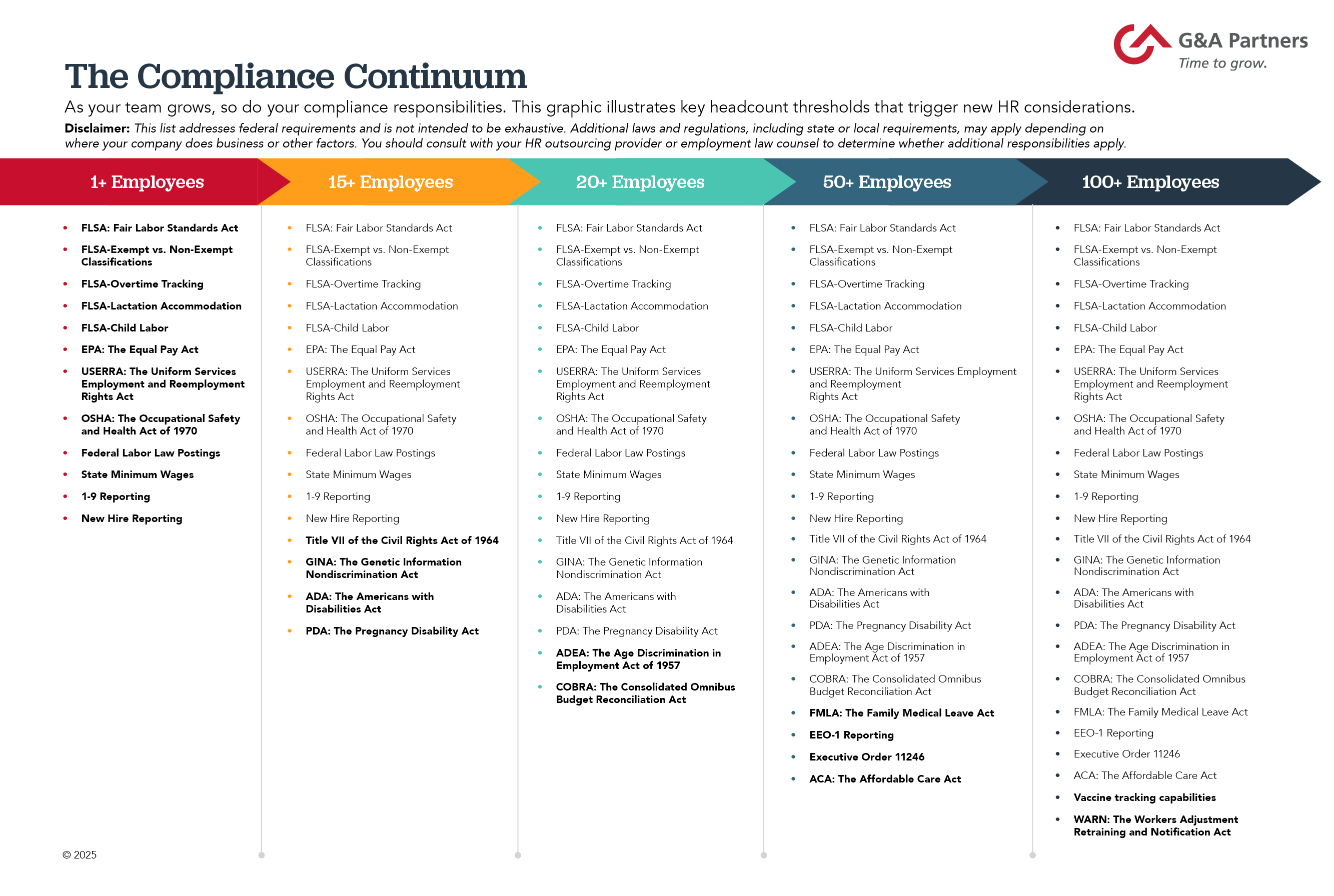
Reaching 15 employees is one of the first major compliance thresholds for growing businesses. At this point, several federal anti-discrimination laws take effect, significantly expanding your responsibilities as an employer and increasing the need for consistent policies, documentation, and decision-making.
These laws are primarily enforced by the Equal Employment Opportunity Commission (EEOC), which sets standards for fair treatment in hiring, promotions, compensation, and workplace conduct, and evaluates whether your policies, decisions, and documentation meet federal standards.
Here are the key laws that apply at 15 employees and what may be required of your business:
Americans with Disabilities Act (ADA)
Once your business reaches 15 employees, the ADA applies. This law requires employers to provide reasonable accommodations to qualified employees with disabilities, unless doing so would create undue hardship.
In practice, this means your business must:
- Engage in an interactive process with employees who request accommodations
- Evaluate job requirements and determine whether accommodations are feasible
- Document decisions and maintain consistency across similar situations
ADA employer requirements are not just limited to physical accommodations. They may also include adjustments to schedules, policies, or work environments, depending on the employee’s needs. As these requests arise, having a clear process for evaluating and documenting accommodations can help ensure consistency and reduce the risk of misunderstandings.
Title VII and the EEOC Employee Threshold
Title VII of the Civil Rights Act is enforced by the EEOC and applies once you reach 15 employees. This law prohibits discrimination based on protected characteristics, including:
- Race
- Color
- Religion
- Sex (including pregnancy, sexual orientation, and gender identity)
- National origin
With Title VII in effect, your business must ensure that all employment decisions, including hiring, promotions, discipline, and termination, are free from discriminatory practices. This is also the point where informal processes can create risk. Without consistent documentation and defined criteria, decisions can appear subjective, increasing the likelihood of complaints or claims.
Establishing clear, objective criteria for employment decisions can help your team apply policies more consistently and reduce the risk of unintended bias.
Pregnancy Discrimination Act (PDA)
The Pregnancy Discrimination Act expands Title VII protections by prohibiting discrimination based on pregnancy, childbirth, or related medical conditions. As an employer, you are required to treat pregnancy-related conditions the same as other temporary medical conditions.
This includes:
- Providing accommodations when appropriate
- Allowing leave under the same conditions as other medical situations
- Avoiding policies that disproportionately impact pregnant employees
Reviewing how your policies apply to different types of medical leave can help ensure pregnancy-related situations are handled consistently and in line with legal requirements.
Operational Changes at 15 Employees
While these laws introduce new legal requirements, the most significant shift is operational. Once laws that apply at 15 employees take effect, informal HR practices are no longer sufficient to support compliance.
At this stage, it’s best for your businesses to move toward more structured processes, including:
- Formal anti-discrimination and workplace policies, typically documented in an employee handbook
- Consistent complaint and investigation procedures, ensuring issues are handled fairly and documented properly
- Manager training, so supervisors understand how to apply policies to ensure consistent decision-making
- Clear documentation standards, including records of hiring decisions, performance issues, and disciplinary actions
As your business crosses this threshold, HR compliance reporting also becomes more relevant. While reporting requirements may still be limited at this stage, accurate documentation becomes essential for defending decisions and preparing for future reporting requirements as you continue to grow.
What Happens at 20 Employees?
While less widely discussed than the 15- and 50-employee thresholds, reaching 20 employees introduces additional compliance requirements, particularly related to age discrimination and employee benefits.
At this stage, compliance responsibilities often begin expanding beyond workplace policies and more deeply into benefits administration, employee eligibility tracking, and documentation requirements.
Here are the key laws and operational changes to be aware of as you cross the 20-employee threshold:
Age Discrimination in Employment Act (ADEA)
When your business reaches an employee count of 20, you are responsible for complying with the Age Discrimination in Employment Act (ADEA). This law protects employees age 40 and older from discrimination in hiring, promotions, compensation, and termination.
In practice, this means your business must:
- Ensure job descriptions and hiring criteria are age-neutral
- Avoid policies or practices that disproportionately impact older workers
- Document employment decisions clearly to demonstrate consistency and fairness
As your workforce becomes more diverse in experience and tenure, consistently applying hiring, performance, and workplace policies can help reduce the risk of age-related bias claims and support fair decision-making across your organization.
COBRA Requirements
The Consolidated Omnibus Budget Reconciliation Act (COBRA) also applies once you reach 20 employees. COBRA requires employers to offer continued health coverage to employees and dependents after certain qualifying events, such as termination or reduction in hours.
To comply, your business must:
- Provide timely COBRA election notices to eligible individuals
- Track qualifying events and coverage timelines
- Administer continuation coverage accurately and consistently
Administering COBRA consistently often requires closer coordination between HR, payroll, and benefits administration. Establishing clear procedures for notifications and eligibility tracking can help reduce administrative errors and support compliance.
Operational Changes at 20 Employees
At this stage, compliance begins extending beyond workplace policies and more deeply into benefits administration, eligibility tracking, and documentation processes. As responsibilities become more interconnected, your business will need more structured coordination between HR, payroll, and benefits administration.
For many businesses, this includes:
- More structured benefits processes, including tracking eligibility and coverage changes
- Clear documentation and notification procedures, particularly for COBRA-related events
- Increased coordination between HR and payroll, to ensure accurate records and timely communication
While the changes at 20 employees may feel incremental, they often signal a broader shift toward more formalized HR systems and administrative oversight — especially as your business approaches the 50-employee threshold.
What Changes at 50 Employees?
Reaching 50 employees is one of the most significant compliance milestones for growing businesses. At this point, your organization becomes subject to more complex regulations related to employee leave and health coverage.
This threshold also introduces more advanced tracking, documentation, and HR compliance reporting requirements. As a result, processes that may have worked manually as a smaller business, now require even more structured systems and oversight to support ongoing compliance.
Family and Medical Leave Act (FMLA)
FMLA applies to private employers with 50 or more employees within a 75-mile radius — provided those workers were employed for at least 20 workweeks in the current or previous calendar year. As a result, understanding when FMLA applies to your business requires a more detailed evaluation than just employee count.
FMLA requires employers to provide:
- Up to 12 weeks of unpaid, job-protected leave for qualifying reasons
- Continuation of group health benefits during leave
- Job restoration upon return
Qualifying reasons include serious health conditions, caring for a family member, or the birth or adoption of a child. And FMLA compliance involves more than approving leave.
As an employer, you are required to:
- Determine employee eligibility
- Provide required notices
- Track leave usage accurately
- Maintain proper documentation
Because eligibility, notices, documentation, and leave tracking all work together under FMLA, having clear procedures in place can help your business better manage leave requests and reduce administrative challenges.
For a more detailed breakdown of FMLA rules and requirements, please read our FMLA FAQ, which addresses common employer questions.
ACA Employer Mandate at 50 Employees
At 50 full-time equivalent employees, your business is considered an applicable large employer (ALE) under the Affordable Care Act (ACA). This triggers the ACA employer mandate, which requires you to:
- Offer affordable health coverage to full-time employees (and their dependents)
- Ensure coverage meets minimum value standards
- Begin coverage in a timely manner — within the ACA waiting period
- Track employee hours to determine eligibility
You must also comply with annual IRS reporting requirements, including:
- Form 1094-C (transmittal form), which summarizes your organization’s overall compliance with the ACA employer mandate and is submitted to the IRS along with all 1095-C forms
- Form 1095-C (employee coverage reporting), which provides each eligible employee and the IRS with detailed information about the health coverage offered to them during the year
These reporting obligations are a core component of HR compliance reporting, requiring accurate data across payroll, benefits, and employee classifications. As your business approaches ALE status, implementing reliable processes for tracking employee eligibility and coverage can help support accurate reporting and reduce compliance risks.
Operational Changes at 50 Employees
At 50 employees, many businesses find that compliance becomes an ongoing operational function that requires consistent oversight. To stay compliant, your organization will also need to become more system-dependent — and manual processes will need to be automated to support growing administrative and reporting demands.
Common operational changes include:
- Leave management systems, to track FMLA eligibility, usage, and documentation
- Benefits administration infrastructure, including eligibility tracking and enrollment processes
- Ongoing workforce monitoring, particularly for full-time equivalent (FTE) calculations
- Expanded HR compliance reporting, including ACA filings and internal recordkeeping
How Employee Counting Actually Works
Understanding how employees are counted is an important part of managing compliance obligations. As previously discussed, many employment laws are triggered by employee count — but calculations are not always as straightforward as looking at your total headcount.
Different laws use different methods to determine whether your business falls within a specific threshold, and factors like part-time employees, related business entities, seasonal workers, and geographic distribution can all affect how your workforce is calculated.
The following considerations help explain how employee counting works in practice:
- Full-time equivalent (FTE) calculations
For certain laws, most notably the ACA, employee count is based on full-time equivalents, not just headcount. This means you must combine the hours of part-time employees to determine how many “full-time” employees they equal.
For example, two employees working 15 hours per week may count as one full-time employee. This calculation is critical for determining whether you meet the 50-employee threshold for Applicable Large Employer (ALE) status.
- Aggregation rules
If your business has common ownership across multiple entities, those entities may be treated as a single employer for compliance purposes. This is known as a “controlled group.”
Even if each entity has fewer than 50 employees, their combined workforce may push you over a threshold for ACA or FMLA applicability. These rules are especially relevant for businesses with multiple locations, subsidiaries, franchises, or shared ownership structures.
- Seasonal worker considerations
Some laws allow limited exclusions for seasonal workers when calculating employee count, but these rules are specific and time bound.
For example, under the ACA, seasonal employees working fewer than 120 days in a year may not count toward the 50-employee threshold in certain situations. However, incorrectly classifying employees or misunderstanding these rules can lead to inaccurate calculations and potential compliance issues.
- The 75-mile radius rule for FMLA
For FMLA specifically, employee count is not just about total headcount but also depends on geographic distribution. The law applies only if you have 50 or more employees within a 75-mile radius of a given worksite.
This means a dispersed workforce may not trigger FMLA in every location, even if your total headcount exceeds 50. However, once a location meets this threshold, all eligible employees within that radius must be covered.
Calculating employee count is a common challenge for growing businesses, particularly when part-time employees, multiple entities, or remote worksites are involved. It’s not uncommon for companies to cross a threshold without realizing it or assume certain requirements do not apply when, in fact, they do.
Because different laws use different counting methods, accurate workforce tracking becomes increasingly important as your organization grows. Whether you’re dealing with laws that apply to 15 or even 50 employees, understanding how employee count is calculated can help you prepare for compliance obligations before they take effect.

State Laws May Trigger Compliance Earlier
While federal employee laws often receive more attention from employers, many state and local employment laws may apply much earlier than expected. In some jurisdictions, certain compliance obligations begin at five employees — or in some cases, even one employee.
For example, California’s Fair Employment and Housing Act (FEHA) applies to employers with five or more employees, extending anti-discrimination protections earlier than federal law. California also applies family leave requirements under the California Family Rights Act (CFRA) at the same threshold.
New York and Oregon also extend certain anti-discrimination protections to very small businesses, in some cases covering employers with just one employee. Local requirements — such as paid sick leave mandates, pay transparency laws, or predictive scheduling rules — may apply regardless of company size.
As a result, businesses operating across multiple states or municipalities may face overlapping compliance obligations that begin well before federal thresholds are reached. Reviewing state and local requirements alongside federal laws can help ensure your policies and processes remain aligned as your workforce grows.
Common Mistakes Growing Businesses Make
As businesses grow, compliance challenges often arise not because employers intentionally ignore requirements, but because responsibilities can expand quickly as new thresholds are reached. In many cases, issues stem from timing, assumptions, or processes that have not evolved alongside workforce growth.
Some of the most common compliance mistakes include:
- Waiting until after crossing a threshold to address compliance requirements, rather than preparing in advance
- Not updating the employee handbook, leaving policies outdated or inconsistent with current laws
- Miscalculating employee count or full-time equivalents (FTEs), especially when part-time or variable-hour employees are involved
- Failing to train managers, which can lead to inconsistent decisions and increased risk of claims
- Assuming remote employees do not count toward thresholds, resulting in inaccurate headcount calculations
- Lacking structured HR compliance reporting processes and systems, making it more difficult to track eligibility, documentation, and required filings
How to Prepare Before You Hit 15 or 50 Employees
Preparing for compliance thresholds is typically far more effective — and less disruptive — when done before new requirements take effect. As your workforce grows, taking a proactive approach can help your business build compliance into everyday operations, rather than reacting to issues after they arise.
As your business approaches 15, 20, or 50 employees, consider taking the following steps:
- Conduct a compliance audit to identify which federal, state, and local laws will apply based on projected headcount and workforce locations
- Review and update policies and your employee handbook to align with current employment laws and workplace practices
- Review your benefits strategy, particularly as you approach ALE status at 50 employees
- Implement proper leave tracking and documentation processes to support FMLA readiness and ongoing compliance
- Train managers on applying policies consistently, responding appropriately to employee concerns, and documenting workplace decisions
- Establish structured HR compliance reporting processes to help track workforce data, eligibility requirements, and required filings accurately
How a PEO Helps You Stay Ahead of Compliance Thresholds
As your workforce grows, managing compliance across multiple laws, systems, and reporting requirements can become increasingly complex. For many SMBs, maintaining consistent oversight across these areas requires significant time, coordination, and specialized expertise. This is where expert support from a PEO can make a real difference.
A professional employer organization (PEO) can help by:
- Monitoring workforce size and alerting you to upcoming compliance thresholds
- Supporting HR compliance reporting, including ACA-related filings, documentation, and workforce tracking
- Assisting with FMLA administration, including eligibility determinations, leave tracking, and required notices
- Helping maintain up-to-date policies and employee handbooks aligned with evolving regulations
- Providing manager training to support consistent, compliant decision-making through all stages of growth
Rather than managing each requirement independently, a PEO helps bring structure and consistency to your compliance processes, allowing your business to grow with greater confidence and less administrative strain.
*Important Legal Disclaimer: Nothing in this material is intended to be, nor should it be construed as, legal or financial advice. Read more.