



- HR Speak
- HR Compliance
- Reasonable Accommodations 101: A Practical Guide for Employers
Reasonable Accommodations 101: A Practical Guide for Employers


In this article, we'll explore:
Reasonable Accommodations 101: A Practical Guide for Employers
What is a reasonable accommodation?
Common Examples of Reasonable Accommodations
The Interactive Process: What Employers Are Required to Do
What is considered an undue hardship?
Mistakes Employers Commonly Make
How Reasonable Accommodations Apply to Remote and Hybrid Work

Employers are receiving more reasonable accommodations requests than ever before — driven by evolving workforce expectations, expanding legal requirements, and increased awareness of employee rights. At the same time, ADA-related claims continue to rise. And many of these claims don’t stem from denying a reasonable accommodation, but from failing to properly engage in the interactive process required under the ADA.
That’s where risk often appears. For small and mid-sized businesses, managing employee accommodation requests can quickly become complex. You may want to support your employees and comply with the law, but without a clear, consistent approach, employee accommodation decisions can become reactive. Even well-intentioned actions can create compliance risk if the process isn’t handled carefully.
In this guide, you’ll learn what qualifies as a reasonable accommodation, how the Americans with Disabilities Act (ADA) applies to your business, and what steps to take to manage requests in a way that is both compliant and practical.
What is a reasonable accommodation?
A reasonable accommodation is a change or adjustment to a job, work environment, or typical way of doing work that enables a qualified employee with a disability to perform essential job functions.
A “qualified individual” is someone who can perform the essential functions of the job with or without a reasonable accommodation.
Under the ADA, employers with 15 or more employees are required to provide a reasonable accommodation unless doing so would create an undue hardship. Its purpose is to ensure employees can perform the essential functions of their role with appropriate support — not to remove core job responsibilities.
For many businesses, understanding ADA reasonable accommodation requirements starts with recognizing that accommodations are not standardized. Each request must be evaluated individually based on the employee’s needs, job requirements, and your business's operational realities.
It’s also important to distinguish between essential and marginal job functions. Employers are not required to eliminate essential duties, but they may need to adjust how those duties are performed.
Who is protected under the ADA?
Understanding who qualifies for a reasonable accommodation is a key part of complying with the ADA. The law protects qualified individuals with disabilities, which includes employees who:
- Have a physical or mental impairment that substantially limits one or more major life activities
- Have a record of such an impairment
- Are regarded as having an impairment
This definition of disability under the ADA is intentionally broad and continues to evolve, particularly as employers see an increase in accommodation requests tied to both physical and mental health conditions.
These disabilities can include a wide range of conditions, such as:
- Long-term or permanent physical impairments
- Temporary conditions, depending on severity and impact
- Mental health conditions, including anxiety, depression, and PTSD
Common Examples of Reasonable Accommodations
There is no fixed list of what qualifies as a reasonable accommodation, but most requests fall into a few common categories. These reasonable accommodation examples illustrate how adjustments can vary depending on the role, the employee’s needs, and the nature of the work.
While many accommodations fall under the ADA, employers are also increasingly managing requests tied to pregnancy, childbirth, and related medical conditions. Recent legislation, such as the Pregnant Workers Fairness Act (PWFA), has expanded employer obligations in this area, making it important to evaluate accommodation requests within the broader context of evolving workplace requirements.
The following categories highlight some of the most common types of employee accommodation requests:
Physical Workplace Adjustments
These accommodations focus on modifying the physical work environment to improve accessibility and usability. In many cases, these adjustments are relatively straightforward and can have a significant impact on an employee’s ability to perform essential job functions.
Examples include:
- Adjusting workstations to accommodate mobility limitations
- Installing ramps, accessible entrances, or modified workspaces
- Providing assistive equipment, such as ergonomic tools or specialized software
Schedule and Policy Modifications
Some employee accommodation requests involve changing when or how work is performed, providing more flexibility for employees to perform their work. These types of accommodations have become more common as workplace expectations and legal requirements continue to evolve.
Examples include:
- Flexible work schedules to accommodate medical appointments or treatment
- Remote or hybrid work arrangements, when job duties allow
- Additional or modified breaks during the workday
- Temporary schedule adjustments related to pregnancy or recovery
Job Restructuring and Reassignment
In some cases, accommodations involve adjusting job responsibilities or placement within the organization. Employers are not required to remove essential job functions, but you may need to explore alternative ways to structure work so the employee can perform effectively.
For example, an employee in a warehouse role recovering from an injury may temporarily be unable to lift heavy items. While lifting may be an essential function for some roles, the employer may be able to shift non-essential tasks, such as inventory tracking or administrative work, to that employee, while redistributing heavier physical duties among other team members.
In practice, this type of accommodation may involve:
- Redistributing marginal (non-essential) job duties
- Modifying how certain tasks are completed
- Reassigning the employee to a vacant role they are qualified for
The Interactive Process: What Employers Are Required to Do
When an employee requests a reasonable accommodation, the ADA requires employers to engage in an interactive process. This is a collaborative, good-faith dialogue between the employer and employee to identify a solution that allows the employee to perform their job.
For many businesses, this is where compliance risk appears. Issues often arise not because an accommodation was denied, but because the process was incomplete, inconsistent, or not properly documented. To remain compliant with ADA requirements, consider the following practical steps when handling employee accommodation requests.
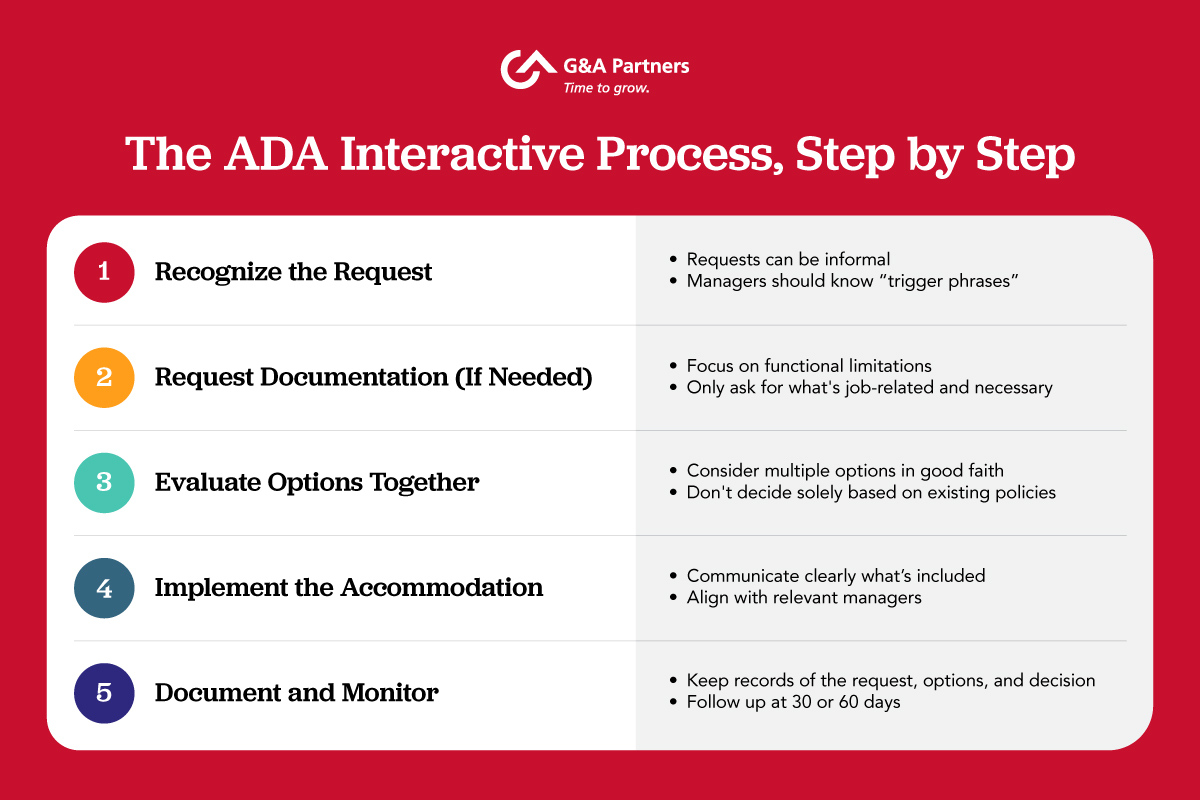
Step 1: Recognizing an Accommodation Request
An employee accommodation request does not need to be formal or use legal terminology. Employees may communicate their needs in simple terms, such as requesting a change in schedule or stating that they are having difficulty completing a task due to a medical condition. Managers are often the first to hear these requests, making their role critical for identifying and escalating them appropriately.
This is especially important because untrained managers may unintentionally overlook or mishandle requests. Providing manager training helps ensure accommodation requests are recognized early and routed through the proper process.
Employers should also make it clear where employees can direct requests. Policies should identify a point of contact, such as HR or a designated manager, so requests are handled consistently.
G&A Expert Tip: Train managers to recognize “trigger phrases,” such as “I’m having trouble because of a medical condition” or “I need help due to a health issue.” These statements may qualify as accommodation requests — even if the employee never uses the word “accommodation.”
Step 2: Requesting Documentation (When Appropriate)
In some cases, employers may request medical documentation to support the need for a reasonable accommodation. However, this step must be handled carefully, as excessive documentation requests can delay the process and create unnecessary compliance risk.
Documentation should focus on understanding the employee’s functional limitations — not diagnosing the condition itself. Employers are generally entitled to information that clarifies:
- The nature of the limitation
- How it affects the employee’s ability to perform essential job functions
- What type of accommodation may be effective
When requesting documentation, employers should:
- Request only information that is job-related and necessary
- Avoid broad or overly intrusive documentation requests
- Maintain confidentiality of all medical information
G&A Expert Tip: If documentation is unclear or incomplete, it’s often better to follow up with targeted questions rather than rejecting the request outright. Engaging in dialogue helps demonstrate good faith and keeps the interactive process moving forward.
Step 3: Evaluating Options Collaboratively
Once a request is identified, employers should engage in an ongoing, interactive dialogue with the employee to explore possible solutions.
This typically involves:
- Discussing the employee’s specific limitations and needs
- Considering multiple accommodation options
- Evaluating what is effective and feasible for the role
As Alexis Knapp, labor and employment attorney and partner at Littler, explains in our 2026 Labor Law Webinar: “We can’t just say, ‘That’s not our policy,’ because, by definition, accommodations sometimes require exceptions.”
This reflects a key compliance principle, as employers cannot rely solely on existing policies to evaluate requests. Instead, they should work collaboratively with the employee to identify a solution that addresses the limitation while aligning with business operations.
Employers are not required to provide the employee’s preferred accommodation, but they must consider options in good faith and select an effective solution.
G&A Expert Tip: Document alternative accommodations you considered — even if they were not selected. This demonstrates that you engaged in a thoughtful, good-faith evaluation rather than making a one-sided decision.
Step 4: Implementing the Accommodation
After evaluating options, the employer is responsible for selecting and implementing the accommodation.
While employees often have valuable insight into what will work best, employers bring an understanding of workplace systems, policies, and operational needs. The final decision rests with the employer, but the accommodation must be effective in addressing the employee’s functional limitations.
In many cases, implementation may involve coordination across teams, adjustments to workflows, or communication with managers to ensure the accommodation is applied consistently.
G&A Expert Tip: Clearly communicate what the reasonable accommodation includes — and what it does not — to the employee and relevant managers. This helps prevent misunderstandings and ensures consistent application across teams.
Step 5: Documenting and Monitoring the Process
Documentation is a critical part of the ADA interactive process framework, but the process does not end once an employee accommodation is implemented.
Employers should maintain clear records of:
- The accommodation request
- Communications with the employee
- Options considered
- The final decision and rationale
This documentation helps demonstrate that the employer engaged in the process in good faith and made decisions based on legitimate business considerations. It also helps protect your business if questions arise later.
Beyond documentation, the accommodation process should be ongoing. Employers should monitor how the accommodation is working and, if needed, make adjustments. Changes in job duties, business operations, or the employee’s condition may require revisiting the accommodation over time.
Maintaining clear records and revisiting accommodations when necessary helps demonstrate good-faith compliance and reduces long-term risk.
G&A Expert Tip: Set a follow-up checkpoint (for example, after 30 or 60 days) to confirm whether the accommodation is working as intended. This reinforces that the process is ongoing — not a one-time decision.
What is considered an undue hardship?
Employers are required to provide a reasonable accommodation unless doing so would create undue hardship for the employer — defined under the ADA as an action that requires significant difficulty or expense.
This determination is not one-size-fits-all. Whether an accommodation rises to the level of undue hardship depends on the specific circumstances of your business and the nature of the request.
Courts and regulators typically look at several factors, including:
- The cost of the accommodation relative to the size and financial resources of the business
- The impact on business operations, productivity, and workflow
- The effect on workplace safety and the ability to perform essential job functions.
In some cases, employers may also consider whether a requested accommodation would create a direct safety risk that cannot be reasonably mitigated.
It’s important to distinguish between true hardship and general inconvenience. An accommodation does not qualify as an undue hardship for the employer simply because it requires schedule adjustments, minor disruptions, additional coordination, or changes to existing workflow. In many cases, these types of disruptions are expected as part of complying with ADA reasonable accommodation requirements.
In practice, many accommodations are far less costly than employers expect. In fact, according to data from the Job Accommodation Network (JAN), 61% of employers reported that accommodations cost nothing to implement, while 33% reported a one-time cost with a median expense of just $300. These findings highlight that many accommodations involve adjustments to schedules, policies, or workflows rather than significant financial investment.
The following examples illustrate how undue hardship is evaluated in real-world situations:
- A small manufacturing company with limited financial resources may receive a request for highly specialized equipment that costs tens of thousands of dollars. If that expense would significantly impact the company’s ability to operate or remain financially stable, it may be considered an undue hardship. However, a larger national organization with greater resources may be expected to absorb that same cost.
- An employee in a warehouse role requests to be permanently excused from lifting heavy items, which is a core duty of the position. Because lifting is an essential job function, removing it would fundamentally change the role. In this case, the employer may instead explore reassignment or alternative accommodations — but is not required to eliminate that essential function.

Mistakes Employers Commonly Make
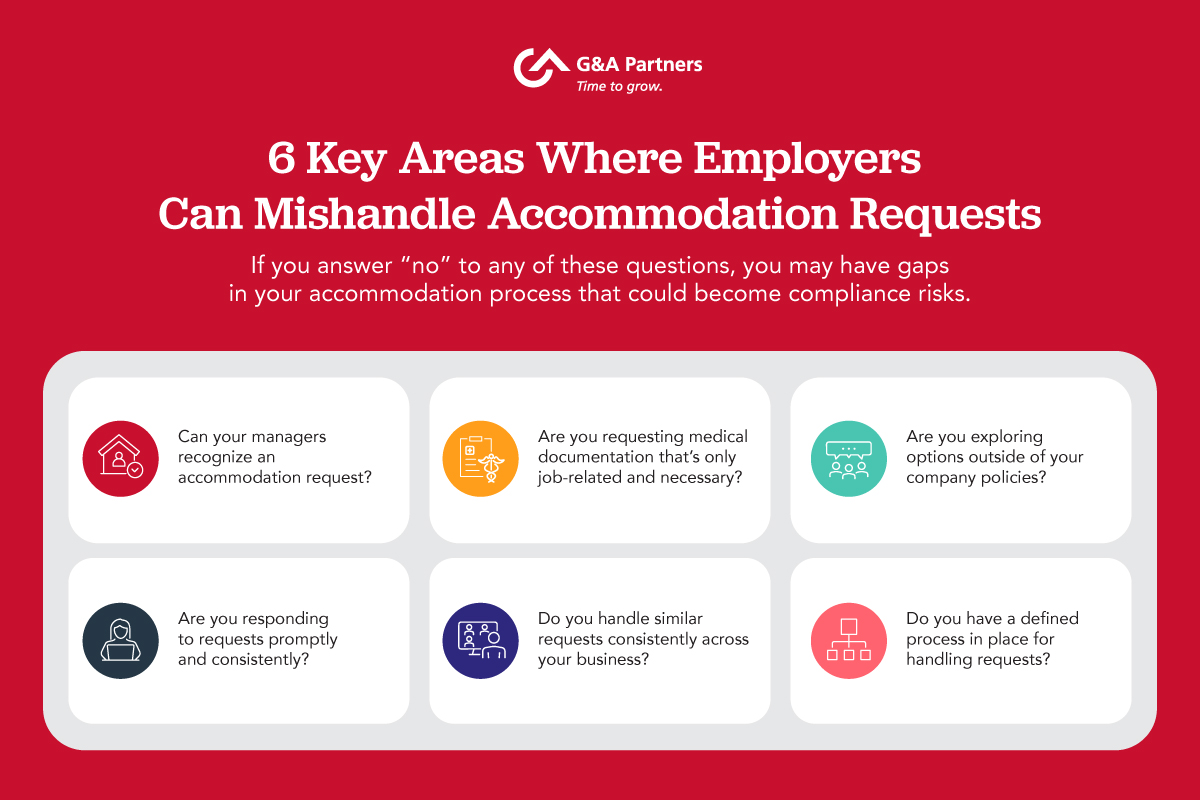
Even when employers intend to comply with the ADA's reasonable accommodation requirements, compliance risks can stem from how requests are handled — not the final decision itself. Missteps in communication, process, documentation, and consistency can create exposure, even for employers acting in good faith.
Understanding where these breakdowns commonly occur can help you build a more consistent, defensible approach to managing employee accommodation requests. Some of the most common include:
Denying Requests Based on Policy Alone
One of the most common issues is responding to a request by pointing to an existing policy. For example, responding with “We don’t allow remote work” or “That’s not how we schedule shifts” can signal a lack of good faith on the employer’s part.
While policies are important for consistency, they cannot replace the need for an individualized assessment. Accommodation laws often require exceptions to standard policies. Failing to explore those exceptions or ending the conversation too early can create compliance risk.
Instead, policies should serve as a starting point, not a final answer. Employers should evaluate whether an exception is reasonable based on the employee’s limitations and the needs of the business.
Failing to Train Managers
Managers are often the first to hear accommodation-related concerns. Without proper training, they may:
- Miss informal accommodation requests
- Respond inconsistently or make off-the-cuff decisions
- Fail to escalate issues to HR or the appropriate contact
These breakdowns can disrupt the interactive process required under the ADA before it begins. For example, if a manager dismisses a request or delays escalating it, the employer may appear unresponsive, even if HR would have handled it correctly.
Providing basic training on how to recognize and escalate requests helps ensure consistency and reduces the likelihood of early-stage missteps.
Over-Requesting Medical Documentation
Employers sometimes request more information than necessary when evaluating a request. This can delay the process, create privacy concerns, and increase your legal risk. Requests for documentation should be limited to what is job-related and necessary.
For example, asking for a full medical history or diagnosis — when only functional limitations are needed — can be viewed as overly intrusive.
When in doubt, focus on understanding how the condition affects the employee’s ability to perform their job, rather than seeking detailed medical information. This keeps the process moving while staying within appropriate boundaries.
Delaying or Rushing the Process
Both delays and rushed decisions can create risk in your efforts to provide reasonable accommodations. Delays may be interpreted as a failure to engage in good faith, while rushed responses may lead to inconsistent or poorly documented decisions.
For example, waiting weeks to respond to a request without clear communication can signal inaction, while making a same-day decision without evaluating options may overlook reasonable alternatives.
A structured, timely approach — acknowledging the request, communicating next steps, and documenting progress — helps demonstrate that you are actively engaging in the process.
Inconsistent Application Across Employees or Locations
Handling similar reasonable accommodation requests differently, especially across departments or locations, can increase compliance risk.
For example, if one employee is granted a flexible schedule or remote work arrangement for a medical condition while another employee with a similar need is denied without a clear, documented reason, such an inconsistency can raise concerns about fairness and potential discrimination.
Consistency does not mean identical outcomes — but it does require consistent reasoning and documentation. Employers should be able to clearly explain why decisions differ based on job duties, operational impact, or other legitimate business factors.
This risk increases for employers managing multistate compliance, as legal requirements may vary by employee location. Even a single remote employee in another state may be entitled to different protections or employee accommodations under state or local laws.
Lack of a Defined Process
Employers without a clear reasonable accommodation process often handle requests reactively. This can result in inconsistent decisions, missed documentation, and increased compliance risk.
Without a defined process, similar requests may be handled differently depending on the manager, timing, or business pressures — making it harder to demonstrate consistency or good faith.
Implementing a simple, structured approach, with a designated point of contact, basic documentation practices, and clear steps, can significantly improve consistency without incurring high costs for the employer or adding unnecessary complexity.
How Reasonable Accommodations Apply to Remote and Hybrid Work
The rise of remote and hybrid work has changed how employers evaluate reasonable accommodation requests, particularly when employees request to work from home. What was once considered an exception is now more common, making it harder to rely solely on blanket policies.
However, remote work is not automatically considered a reasonable accommodation. Instead, employers must evaluate whether working remotely allows the employee to perform the essential functions of their role without creating undue hardship.
When an employee requests remote or hybrid work as an accommodation, the evaluation typically comes down to a few key questions:
- What are the essential functions of the role?
- Can those functions be performed effectively in a remote or hybrid environment?
- What impact would the arrangement have on operations, collaboration, and performance?
For example, a role that requires in-person customer interaction, hands-on equipment use, or on-site supervision may not be suitable for remote work. In contrast, roles that are primarily computer-based or independent in nature may be more adaptable to remote or hybrid arrangements.
It’s also important to consider how past practices may influence expectations. Many organizations operated remotely during the pandemic, and employees may point to that period as evidence that their job can be performed from home. While this can be a relevant factor, it does not automatically mean remote work is a reasonable accommodation today. Business needs, team structure, and operational requirements may have evolved.
As with all reasonable accommodation requests, the key is individualized assessment — not assumptions. Employers are not required to approve remote work in every case, but they should be prepared to evaluate it thoughtfully and document their reasoning.
For businesses with distributed teams, this also introduces additional multistate compliance considerations. Requirements may differ based on where employees work, even within the same organization.
*Important Legal Disclaimer: Nothing in this material is intended to be, nor should it be construed as, legal or financial advice. Read more.