
- HR Speak
- HR Compliance
- Managing HR Compliance For Your Growing Small Business
Managing HR Compliance For Your Growing Small Business


In this article, we'll explore:
Managing HR Compliance For Your Growing Small Business
What Is HR Compliance Management?
Is It Illegal for a Company Not to Have HR?
H2: What Is the Difference Between HR and HR Compliance?
How Do You Ensure HR Compliance in the Workplace as Your Business Grows?
What Are FMLA, ADA, and ACA — and When Do They Apply to Your Business?
How Do You Manage HR Compliance Across Multiple States?
What Is an Example of Compliance Risk?
How Do You Improve HR Compliance as a Small Business?FAQ: HR Compliance for Small Business

HR compliance for small business means following the federal, state, and local employment laws that apply to your company, and keeping documented policies and processes that help show you’re doing so. You don’t need a full in-house HR department to manage it well.
Growth is worth celebrating, and it also brings a longer to-do list. Each new hire, location, or state can add rules, deadlines, and paperwork, often before you’ve had time to research what’s changed. For many business owners, HR compliance ends up squeezed in around everything else only they can do.
That’s where the right partner can help. Many growing businesses work with an HR outsourcing provider, such as a professional employer organization (PEO), whose team keeps up with changing requirements and helps you understand what applies to your business. You keep running your company, and you have experienced people alongside you as it grows.
What Is HR Compliance Management?
HR compliance management is the practice of making sure your business follows the employment laws and regulations that apply to it through clear internal policies and procedures. These laws exist at the federal, state, and local levels and affect nearly every function of HR.
Key labor laws and regulations include (but are not limited to):
- Title VII of the Civil Rights Act
- Fair Labor Standards Act (FLSA)
- Equal Pay Act
- Age Discrimination in Employment Act (ADEA)
- Americans with Disabilities Act (ADA)
- Pregnancy Discrimination Act (PDA)
- Occupational Safety and Health (OSH) Act, enforced by the Occupational Safety and Health Administration (OSHA)
- Employee Retirement Income Security Act (ERISA)
- Family and Medical Leave Act (FMLA)
- Affordable Care Act (ACA)
Several states have their own wage, hour, and leave requirements that go beyond federal standards, along with requirements such as state-mandated retirement plans.
As your business grows — whether you’re acquiring companies in other locations or hiring remote employees in new states — multistate compliance can get complicated fast, since you have to meet the requirements of every location where you have employees. (We cover multistate compliance in more detail below.) A key part of HR compliance management is simply staying aware of which federal, state, and local laws apply everywhere you do business.
Also, some labor laws aren’t applicable until your business hits an employee headcount threshold. For example, the ACA employer mandate generally applies once you have 50 or more full-time equivalent employees. Others apply to any business with one or more employees, so your regulatory compliance requirements will vary as your business continues to grow.
For a growing business, HR compliance management should include a strategy that:
- Anticipates growth milestones
- Keeps you aware of which requirements apply now, and which are coming next
Documents a plan for meeting each on, including a signed employee handbook, clear job descriptions, and a consistent onboarding process new hires can point back to
Is It Illegal for a Company Not to Have HR?
No. Companies aren’t legally required to dedicate a team, department, or individual to human resources. But skipping dedicated HR support can create real risk for your business.
While it’s not required by law, having the right HR resources in place can reduce risk, unlock real benefits, and help set your company up for long-term success.
Here’s what your small or mid-size business could gain by having dedicated HR support:
- Improved HR processes: Managing daily HR tasks without dedicated support can lead to inefficiencies and delays. With HR resources in place, these tasks are handled more smoothly and consistently, ensuring your business runs more efficiently.
- Timely regulatory reporting: A number of laws and regulations have reporting deadlines your business must meet. Without an HR resource to stay on top of it, you can face penalties for missed deadlines.
- Trust with your employees: Who can your employees turn to if they have a personnel issue to discuss, a complaint, or questions about their benefits or paycheck? With dedicated HR resources in place, employees know who they can turn to. And when employees know HR is committed to overall HR compliance management and adherence with labor laws, it builds more trust between your business and workers.
- Compliance with labor laws and regulations: One of HR’s main responsibilities is to ensure your business and employees are adhering to employment laws and regulations at the federal, state, and local levels through internal policies, procedures, and training. Without a dedicated HR resource to manage these ever-changing requirements, your business risks noncompliance and potential fines, penalties, and lawsuits.
- Better employee retention and recruitment. A more efficient, safe, and fair workplace contributes to higher employee retention rates and allows your business to more easily attract top talent.
Often, small and mid-sized businesses simply don’t have the time or in-house expertise to manage all of this. Rather than risk noncompliance, many turn to an HR outsourcing provider to help manage these responsibilities and free up time for the work only they can do.
What Is the Difference Between HR and HR Compliance?
HR covers everything related to your people, from hiring and onboarding to performance and employee relations. HR compliance is the part of human resources focused on following the employment laws that apply to your business.
HR’s primary function has long been rooted in compliance: ensuring new hires complete the right paperwork, handling complaints and personnel disputes fairly, and processing payroll accurately and on time. Over the last two decades, as human capital management has taken hold, HR’s role has grown well beyond legal compliance alone.
Today, HR is often more strategic and recognizes people as a company’s greatest asset. Strategic HR is focused on:
- Helping employees do their best work and grow with the company
- Engaging employees and improving the overall employee experience
- Unlocking the potential of employees
- Maximizing employees’ productivity and value to the organization
A human resources team achieves this through recruitment, onboarding, training, performance management, performance reviews, employee relations, and more.
HR compliance, on the other hand, is the adherence to federal, state, and local labor laws and regulations. It’s achieved by understanding what applies to you, assessing risk, and mitigating potential losses, then educating employees, implementing policies and procedures, and enforcing them consistently.
How Do You Ensure HR Compliance in the Workplace as Your Business Grows?
Start by tracking your headcount, because many employment laws apply only once you reach a certain number of employees. Knowing which thresholds are coming helps you plan for new requirements before they arrive.
What Employee Headcount Thresholds Should You Watch?
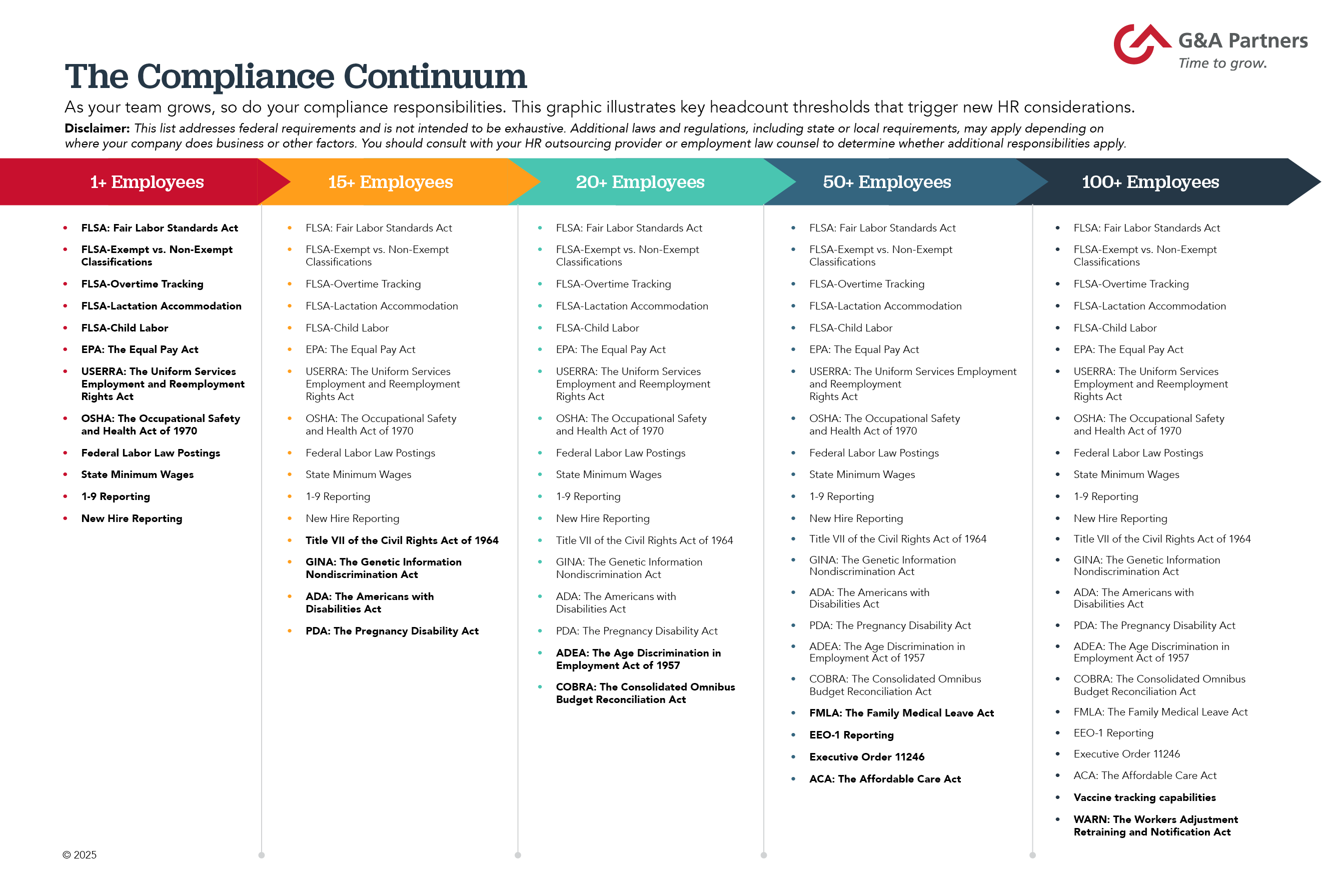
The thresholds growing businesses watch most are 1, 15, 20, 50, and 100 employees. Each one adds requirements, and the laws that applied before still apply. Here’s what typically applies at each level:
- One employee: Even with a single hire, your business must meet requirements under the Fair Labor Standards Act (FLSA), new-hire and Form I-9 reporting, the Equal Pay Act, required workplace posters, and the Uniformed Services Employment and Reemployment Rights Act (USERRA). OSHA workplace safety standards apply here, too.
- 15 or more employees: Protections under Title VII of the Civil Rights Act of 1964, the Americans with Disabilities Act (ADA), and the Pregnancy Discrimination Act (PDA) now apply.
- 20 or more employees: Your business is now subject to the Age Discrimination in Employment Act (ADEA) and COBRA.
- 50 or more employees: This is a big one for many growing small businesses because it brings ACA health coverage requirements (counted as 50 full-time equivalent employees) and FMLA eligibility for your workforce.
- 100 or more employees: The Worker Adjustment and Retraining Notification (WARN) Act applies, and you’ll also need to file an annual EEO-1 report with the Equal Employment Opportunity Commission (EEOC).
Not every law counts employees the same way, and the sections below explain how it works for FMLA, ADA, and ACA.
Some states set lower thresholds. Connecticut, for example, has leave laws that apply to private employers with just one employee, so it’s important to know the state and local employment laws where your employees work.
For a small business, keeping track of all this can feel overwhelming, especially when you’re also running the business. An HR outsourcing provider, such as a PEO, or an employment law attorney can help you keep up with changing requirements.
Which HR Documents and Processes Protect Your Business?
Headcount thresholds tell you what applies. Documentation is how you prove you’re following it. A few foundational pieces go a long way:
- An employee handbook that spells out your policies clearly, from paid time off to disciplinary actions, so expectations are consistent for everyone.
- Written job descriptions for every role, which support fair pay practices and defensible hiring and performance decisions.
- A standard onboarding process that captures required paperwork, such as Form I-9 and tax withholding forms, consistently.
- Clean recordkeeping, so if a question or claim ever comes up, you have the documentation to answer it.
None of these are hard requirements at every headcount level, but together, they give you a stronger compliance foundation and help you demonstrate that your policies and processes are in place if you’re ever audited or challenged.
What Are FMLA, ADA, and ACA — and When Do They Apply to Your Business?
Three of the laws small business owners ask about most are FMLA, ADA, and ACA. Here’s what each one requires.
What Is FMLA and When Must Small Employers Comply?
The Family and Medical Leave Act (FMLA) entitles eligible employees to up to 12 weeks of unpaid, job-protected leave for qualifying family or medical reasons, such as the birth or adoption of a child or a serious health condition affecting the employee or a close family member.
FMLA applies once you have 50 or more employees working within 75 miles of a given worksite. Individual employees must also have worked for you for at least 12 months and logged at least 1,250 hours in the past year to be eligible. While an employee is out, you’re required to maintain their group health coverage and restore them to their same or an equivalent role when they return.
What Is the ADA and When Must Small Employers Comply?
The Americans with Disabilities Act (ADA) is one of several federal anti-discrimination laws, alongside Title VII and the ADEA. It prohibits discrimination against qualified employees with disabilities and requires employers to provide reasonable accommodations that let them perform essential job functions, unless doing so would cause undue hardship on the business.
The ADA applies once you have 15 or more employees. Common accommodations, such as modified schedules, accessible workspaces, or adjusted equipment, are usually lower-cost and easier to implement than owners expect.
What Is the ACA and When Must Small Employers Comply?
The ACA requires applicable large employers — generally those with 50 or more full-time equivalent employees (FTE) — to offer health insurance that meets minimum value and affordability standards or face potential penalties.
If you’re under that 50-employee threshold, ACA’s employer mandate doesn’t apply to you yet. But it’s worth planning for before you get there, especially when you’re also running the business and don’t have the hours to spend researching labor laws. These thresholds shift depending on how you count employees, so it’s worth confirming your specific numbers with an HR compliance expert or employment attorney rather than guessing.
Ready to see how your business measures up?
Our free HR Compliance Checklist walks through the federal and state essentials every growing small business should have in place, from required postings to paperwork to policies.
How Do You Manage HR Compliance Across Multiple States?
If you have employees working in more than one state, through remote hires, a new office, or an acquisition, multistate compliance is the next challenge to plan for. In short, you must follow the employment laws of every state (and sometimes city) where your employees work, not just where your company is headquartered.
That gets complicated quickly, because states differ on:
- Wage and hour laws, including minimum wage and overtime pay
- Paid sick leave and other leave requirements
- Final paycheck timing after termination
- Required workplace posters and new-hire notices
- State tax withholding and unemployment insurance registration
A remote employee working from a different state than your headquarters is still subject to that state’s laws, even if the rest of your team isn’t. An employer with 50 employees companywide, for example, could still owe paid sick leave to a single employee working in a state that requires it for businesses with just one worker.
Growing across state lines is a good problem to have, but it’s also where compliance risk multiplies fastest. It’s exactly the kind of challenge an HR outsourcing partner earns its keep on: HR that grows with you, so each new state is one more thing you don’t have to research alone.
What Is an Example of Compliance Risk?
Compliance risk is the legal and regulatory risk your business faces if it falls out of step with labor laws, standards, or regulations. It’s separate from the strategic, operational, or financial risks every business also manages.
Compliance risk management is focused on identifying, assessing, and mitigating those risks and potential losses due to noncompliance with laws, standards, and regulations.
Within HR, some examples of compliance risk include, but are not limited to:
- Pay equity or pay transparency
- Employee classification — exempt vs. nonexempt and employee vs. independent contractor
- Overtime pay calculations
- Minimum wage compliance
- Discrimination in hiring, promotions, or other employment decisions
- Workplace safety standards
- Recordkeeping and record retention
- Employee training requirements
- Employment eligibility verification (Form I-9)
- Employee data privacy
Noncompliance in any HR-related area can carry significant consequences, such as fines or penalties, lawsuits, damage to the company’s reputation, erosion of employee-employer trust, difficulty retaining customers or talent, and more. And if your business has repeated violations or is found to be willfully negligent, it could be subject to government oversight and costly compliance mandates. With clear policies, consistent documentation, and the right support, you can spot and address issues early.

How Do You Improve HR Compliance as a Small Business?
Improving HR compliance starts with knowing which laws apply to your business, putting clear policies and documentation in place, and getting expert support as your requirements grow. Keeping up with all applicable and new laws is often difficult for business owners to track on their own. Outsourcing partners spend their days on this work, and they can help you sort out what applies today and what’s coming next.
Outsourcing your HR can lighten that load, help you work through compliance requirements, and give you more time to focus on your business. It also scales as you do.
How Does a PEO Help You Scale HR Compliance?
A PEO helps you scale HR compliance by pairing compliance guidance with hands-on support for payroll, benefits administration, and HR management, so your support grows as your headcount and obligations do. PEOs work through a co-employment arrangement, where you and the PEO share certain employer responsibilities while you keep running your business and making personnel decisions.
Many PEOs also provide HR software that centralizes onboarding, time tracking, and offboarding in one place. Because a PEO already has teams of experts supporting companies of all sizes, it can flex to match your business as your compliance obligations grow.
Here’s how this can play out for two hypothetical owners:
A Small Business That Handles HR Internally
A small business owner shares HR and compliance tasks with an office manager while both handle their regular jobs. They learn as they go, and now and then, a payroll error or an incorrect employee classification slips through. As demand grows, the owner hires an HR manager, which takes several months to fill and more time for the new hire to get up to speed. A year later, the team has grown again, and the HR manager, whose background is in payroll, is working through benefits, workplace safety, and changing regulations with spreadsheets and manual processes. Adding another HR hire would mean another months-long search.
A Small Business That Partners With a PEO
A small business owner has been handling most HR tasks alone, and the growing workload and ever-changing employment laws are wearing on them. With an acquisition ahead, the owner partners with a PEO. The owner continues to make business decisions, while the PEO’s team supports payroll, benefits, compliance, and HR administration, recommends steps when the business may be at risk, and helps onboard newly acquired employees. A year later, a second acquisition could push the company across a headcount threshold. The PEO flags early that ACA health coverage requirements may now apply, and the owner works with the team to plan coverage before the deal closes.
Which Other Providers Help Small Businesses Avoid Compliance Mistakes?
Beyond a PEO, there are several credible paths to HR compliance support — and they’re not mutually exclusive:
- Hire a dedicated HR professional. Keeps HR in-house, though it comes with a salary cost, and one person is unlikely to be an expert in every area of HR.
- Choose an HR outsourcing (HRO) provider. Allows you to pick and choose the services you need, HR compliance included.
- Hire an HR consultant. A good option if you have in-house HR that needs extra hands for compliance projects, HR audits, or writing workplace policies and employee handbooks.
- Engage a PEO. A PEO gives you a team of HR experts who handle back-office administration and provide compliance guidance.
- Hire an employment law attorney. Keeps you current on the latest labor laws, advises on personnel issues, and represents you if a dispute goes to court.
- Consult with federal and state agencies. From website resources and newsletters to hotline support, federal and state agencies are eager to help small businesses. Check their websites for additional resources, such as the Department of Labor’s summary of major labor laws or Fair Labor Standards Act (FLSA) toolkit.
These options work well together, too. Many small businesses combine an employment law attorney’s guidance with a PEO like G&A Partners, using the attorney for legal advice and the PEO for HR administration, technology, and compliance support. Together, they give you legal advice and ongoing HR support, with each bringing its own expertise.
Whichever combination fits your business, you’re not doing this alone.
FAQ: HR Compliance for Small Business
What is HR compliance for a small business?
HR compliance for a small business means following the federal, state, and local employment laws that apply to your company, from wages and safety to leave and benefits, and having documented policies that help you demonstrate it. It also means keeping up as new laws take effect or your headcount grows.
Do I need an in-house HR department to stay compliant?
No. Many small businesses manage compliance by partnering with an HR outsourcing provider, HR consultant, or PEO instead of hiring in-house. What matters most is having the right resources and processes in place to understand and meet the requirements that apply to your business.
Which providers help small businesses avoid compliance mistakes as they grow?
There are several ways small businesses can get HR compliance support, including an HR professional, HRO provider, HR consultant, PEO, or employment law attorney. An administrative services organization (ASO) can be a good fit for businesses that want to keep employer responsibilities in-house while outsourcing specific HR functions, without entering into a co-employment relationship. These options can also work together depending on your business’s needs.
What happens if a small business isn’t compliant with labor laws?
Consequences vary by violation but can include fines, penalties, lawsuits, and reputational damage. Many compliance issues can be avoided or reduced when clear policies, documentation, and expert guidance are in place before a question arises.
H3: How does HR compliance change when I hire employees in another state?
You become responsible for that state’s employment laws in addition to your own, including its minimum wage, leave, and posting requirements, even for a single remote employee. It’s one of the fastest ways compliance responsibilities multiply as you grow.
*Important Legal Disclaimer: Nothing in this material is intended to be, nor should it be construed as, legal or financial advice. Read more.