


- HR Speak
- HR Outsourcing & PEO
- PEO Renewal Checklist: What to Evaluate Before You Sign Again
PEO Renewal Checklist: What to Evaluate Before You Sign Again



If your professional employer organization (PEO) renewal is coming up, doing nothing is a decision, and often an expensive one.
Costs can increase without clear explanation, and service models vary widely. Renewal periods can pass quickly, and without a clear evaluation, many businesses move into another term without reassessing their provider.
The bigger risk is not necessarily cost. It’s staying with a provider that no longer fits how your business operates or grows.
Renewal is one of the few natural points where you can step back and take a hard look at whether your current provider still fits your business. Outside of renewal, many companies delay that evaluation until service issues become too disruptive to ignore, in part because exiting a PEO agreement early can be complex and costly.
If you are reevaluating your current PEO, this checklist highlights the factors that matter most: pricing transparency, service quality, benefits plan flexibility, compliance support, and employee experience.
Signs It's Time to Switch PEO Providers
Not every frustration means you need to switch PEOs, but consistent issues are usually a sign your provider is not built to support your business at its current stage.
Companies often reevaluate their PEO when service gaps, operational friction, or rising renewal costs become too difficult to ignore.
If you recognize any of the patterns below, it may be time to reassess your current provider:
1. Pricing That’s Getting Harder to Justify
- Costs increase without a clear explanation at renewal
- Pricing changes as your business grows and that become harder to predict
- Your invoice is difficult to break down, so you cannot clearly tie charges to specific services or value
You should understand exactly what you are paying and why. If pricing is difficult to explain or forecast, it becomes harder to budget and control costs as your business grows.
2. Service That Feels Reactive, Not Supportive
- You are routed through different contacts instead of consistently working with someone who understands your business
- Issues take too long to resolve
- Your provider only reaches out when something goes wrong, instead of helping you stay ahead of problems
When service becomes inconsistent, it creates friction across your entire organization and slows down day-to-day operations.
3. Compliance Support That Leaves You Guessing
- Your team is left reacting to regulatory changes instead of preparing for them
- Multistate requirements feel unclear or unsupported
- Your internal team is left interpreting compliance risk
If your team is still carrying the burden of compliance, the model is not working as intended.
4. Technology That Slows You Down
- Routine tasks still require manual work or support from your provider
- Reporting is difficult to access or does not provide clear insights
- Systems do not integrate with your existing tools
Technology should improve efficiency, not create workarounds or blind spots.
5. An Employee Experience That’s Falling Short
- Employees cannot easily handle routine self-service tasks like updating information, requesting time off, or accessing policies
- Employees do not have clear resources or guidance to help them understand their benefits
- Errors or inconsistencies create frustration during key moments like open enrollment or a qualifying life event
Employees often feel the impact of a weak PEO before leadership does.
Early signs like slower response times, unresolved questions, and inconsistent support can create frustration long before the issue shows up as turnover, disengagement, or operational risk. Gallup reported that U.S. employee engagement averaged 31% in 2025, down from its 2020 peak of 36%, with the decline tied in part to lower clarity, communication, and feeling cared about at work.
If several of these issues sound familiar, it’s worth taking a closer look at your current PEO relationship before your renewal window locks you into another term. The goal is not only to fix what’s broken but also to make sure your PEO is actively supporting your business as it grows.
The Complete PEO Renewal Checklist
Before you renew your contract, use this checklist to evaluate your current PEO relationship and compare other providers if you are considering a switch. Some questions are designed to help you assess your existing service model, while others can help you evaluate new options side by side.
1. Fees & Pricing Transparency
Start by understanding exactly how your PEO charges you and how those costs change as your business grows. Reducing costs while creating predictable, controllable HR expenses is the ultimate goal.
Ask:
- Is pricing per employee or tied to payroll percentage?
- What costs increase automatically at renewal?
- What services are included in your base fees, and what is billed separately?
What to watch for:
- Pricing that becomes harder to predict as your business scales
- Fees that are bundled together, making it difficult to understand what you are actually paying for
You should expect:
- Clear, itemized pricing that shows exactly what you are paying for
- Costs that remain stable as your business grows, without unexpected increases tied to bonuses or overtime
- Renewal conversations that outline changes in advance, not after they take effect
2. Service & Support Quality
The biggest difference between PEO providers is how they show up when you need support. Consistent access to knowledgeable experts who understand your business can significantly reduce internal workload and free up your team to focus on strategic initiatives that drive the bottom line.
Ask:
- How is your account supported day to day, and who will be responsible for knowing your business?
- What specific timelines do you commit to for resolving issues, especially for payroll or compliance, or responding to HR management questions?
- How does your team proactively monitor for risks such as wage and hour issues or misclassifications, and can you share an example of an HR or compliance issue your team flagged early, along with the recommended action?
What to watch for:
- Having to explain your business or repeat issues to a different contact each time
- Waiting days for responses to time-sensitive issues like payroll or compliance
- Getting slow or unclear guidance on employee disciplinary issues or terminations when timing and documentation matter
You should expect:
- A consistent point of contact who becomes familiar with your business over time
- Response times that are measured in hours, not days, especially for payroll or compliance issues
- Guidance that helps you plan ahead, not just resolve problems after they happen
3. Compliance & Risk Management
Compliance is one of the primary reasons companies partner with a PEO, but the level of support can vary significantly between providers.
Ask:
- How are regulatory updates communicated?
- Does your provider support multistate compliance?
- Is your payroll and HR technology set up to support compliance changes such as minimum wage updates, tax changes, and state-specific requirements?
- Who is responsible if something goes wrong?
What to watch for:
- Compliance alerts do not clearly explain what changed, how it affects your business, or what action is required
- Unclear guidance or gaps in support when operating across multiple states
- Technology does not adapt easily to changing compliance requirements across states or jurisdictions
You should expect:
- Clear compliance updates that explain the employer impact and any decisions your team needs to make
- Clear direction on what actions your business needs to take and when
- Access to specialists who can answer questions specific to the locations you operate in, industry, or situation
4. Technology & Reporting
Technology plays a supporting role in how efficiently your team operates. It should make it easier to manage your workforce, not add complexity or require workarounds. When questions come up, access to real people is just as important as the platform itself.
Ask:
- What can employees and managers handle directly in the system, and what still requires provider support?
- What reports are included by default, and what requires custom reporting, added fees, or extra turnaround time?
- How does the platform connect with your existing tools, and where does manual work still happen?
- What technology is included in the base service, what is optional, and what carries added cost?
- What alerts does the system generate for compliance-sensitive events, who receives them, and what action is required?
What to watch for:
- Relying on your provider or your people managers to complete routine tasks
- Reports do not give you access to the specific workforce data or insights your team needs
- Systems that do not integrate with your existing tools or require extensive professional services to do so
- You are paying for technology modules or applications your team does not use
You should expect:
- Self-service tools that reduce manual work for your team and employees
- Reports that are available on demand and easy to pull when your team needs them
- Technology that fits your workflows and connects with the systems you already use
- Technology options that can be tailored to your needs, so you are not overpaying for unused tools
5. Employee Experience
Employees experience your PEO every day, through benefits, payroll accuracy, and support. When something breaks, it affects retention, satisfaction, and trust.
Ask:
- What benefits are available, how are they explained to employees, and what examples can you share from open enrollment materials or employee communications?
- What service levels apply to employee HR and benefits questions, and how do employees get help when they need it?
- What does open enrollment actually look like for employees, including communications, decision support, deadlines, and issue resolution?
- How often do payroll errors, delays, or corrections affect employees, and how is that tracked and communicated?
What to watch for:
- Employee payroll, tax, or benefits questions that are repeatedly redirected back to your internal team
- Open enrollment materials that are unclear, incomplete, or hard to follow
- No documented response times for employee payroll, benefits, or HR questions
- Frequent payroll corrections, delayed issue resolution, or recurring employee complaints
You should expect:
- Benefits that help you stay competitive for talent and meet the needs of your workforce
- Easy access to benefits resources, enrollment tools, and support when employees need information or help
- An online enrollment process that is organized, communicated clearly, and free of avoidable errors
Use this summary to quickly compare where your current provider may be falling short and what a stronger partnership should look like.
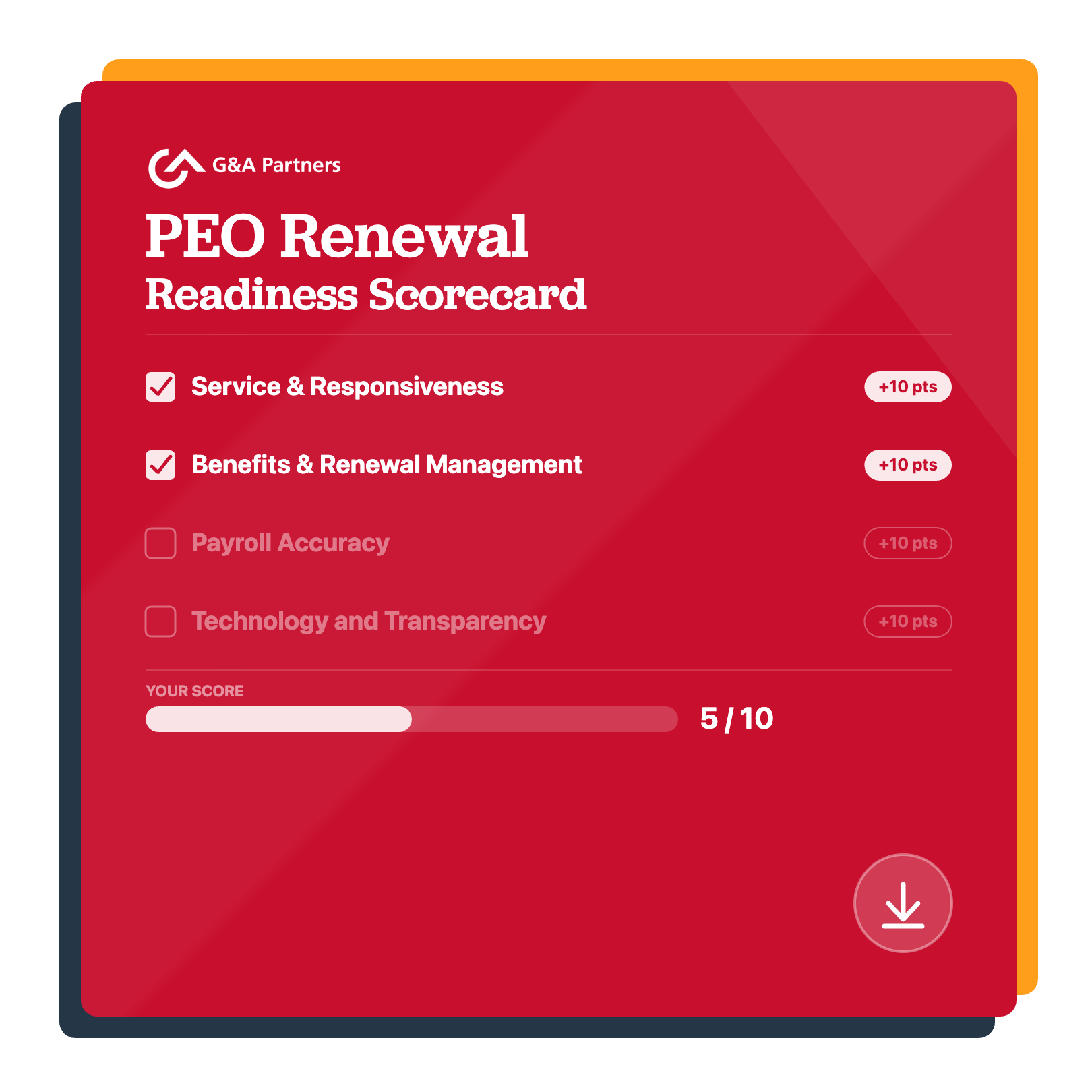
PEO Renewal Readiness Scorecard
Is your PEO working for you? This scorecard gives you a structured way to evaluate your current provider across four categories: service, benefits, compliance, and pricing.
Stay vs. Switch: A Simple Decision Framework
After completing your evaluation, the decision typically comes down to whether your current provider is still supporting your business or creating friction.
Use this framework to assess whether your PEO is still aligned with your business today and where you're headed next.
When Staying May Make Sense
Your current provider may still be the right fit if:
- Day-to-day operations run smoothly without constant follow-up or escalation
- Pricing remains predictable and aligned with the value you receive
- Your provider continues to support your business as it grows in size or complexity
- Your team feels confident handling issues because the right support is in place
- Your technology is intuitive and helps streamline routine tasks instead of creating extra work
If your PEO is delivering across these areas, renewal may be the simplest and most effective path forward.
When Switching May Be Worth Exploring
It may be time to explore other options if:
- Service gaps are creating friction for your team or negatively impacting employees
- Pricing has become unclear, inconsistent, or difficult to justify as you grow
- You’re running into limitations around flexibility, customization, or service scope
- Your provider no longer fits your business size, structure, or operational complexity
- Technology, reporting, or access to data is slowing down decision-making
In these cases, switching is not just about fixing issues. It is about finding a partner better equipped to support your next stage of growth.

What Switching PEOs Actually Looks Like
One of the biggest reasons companies stay with an underperforming PEO is the assumption that switching will be highly disruptive. In reality, a well-managed PEO transition is structured, supported, and designed to keep your business running smoothly.
With G&A, the PEO onboarding process typically takes five to seven weeks, though the implementation timeline can vary based on company size, payroll complexity, and technology needs. During that time, your business generally continues operating under its current payroll and HR structure until the first payroll with the new provider is complete.
A successful PEO transition should have clear ownership, defined milestones, and support from both your provider and internal team. When managed well, switching does not have to create unnecessary disruption for your employees or day-to-day operations.
Timing Your Transition
Starting 60–90 days before your renewal date gives you enough time to review your CSA for any 30-, 60-, or 90-day written notice requirements, evaluate options, make a decision, and transition without unnecessary pressure.
Because the PEO onboarding process typically takes five to seven weeks, starting early helps reduce the risk of rushed implementation, missed deadlines, or service gaps.
- January 1 transition (best-case scenario): Aligning your switch with the start of the calendar year simplifies benefits enrollment, avoids duplicate W-2s, and ensures employees maintain continuity with deductibles and coverage.
- Mid-year transitions: Switching mid-year is still very possible — especially if you’re experiencing service issues or contract concerns — but it requires more coordination around payroll taxes (FUTA/SUTA) and benefits tracking.
What Happens Behind the Scenes
A well-managed transition should not require constant involvement from your internal team.
1. Payroll & Tax Setup: Your new PEO assigns the necessary federal and state tax IDs and coordinates payroll setup to help keep the transition on track. Your team will still need to provide required information and complete key onboarding tasks, but day-to-day administrative burden should be reduced.
2. Benefits Transition: A capable PEO coordinates directly with insurance carriers, manages deductible transfers where possible, and communicates clearly with employees to avoid confusion or gaps in coverage.
3. Data Migration: Employee records, payroll history, and benefits information are securely transferred into the new system. Your team will still need to provide the required data and review key details, but modern platforms and onboarding teams help reduce manual work and limit the risk of errors.
Plan Ahead for Your PEO Renewal
PEO contracts operate on strict renewal timelines, and missing key deadlines can lock you into another term before you have had the chance to fully evaluate your options.
Timing matters because a successful transition depends on more than giving notice. Company size, payroll complexity, multistate operations, benefits setup, and technology requirements can all affect how long onboarding takes. Businesses with more complex needs may need more lead time to avoid rushed implementation or delays tied to their first payroll.
Use this timeline to stay in control of the decision:
90 days out: Start your evaluation. Use this checklist to assess your current provider and gather feedback from internal stakeholders.
60 days out: Explore alternatives and request proposals. Address any pricing, service, or contract concerns directly with your current provider.
30 days out: Confirm notice requirements and finalize your transition plan if you are moving forward with a switch.
Businesses with more complex payroll, benefits, or compliance needs should plan to start this process earlier.
Your PEO should make running your business more efficient, not more complex, as you grow. If you are experiencing rising costs, service gaps, or limited flexibility, renewal is the right time to reassess what you need from a partner.
G&A Partners can help you evaluate your options, identify gaps, and build an HR strategy that supports how your business operates today and where it is headed next.
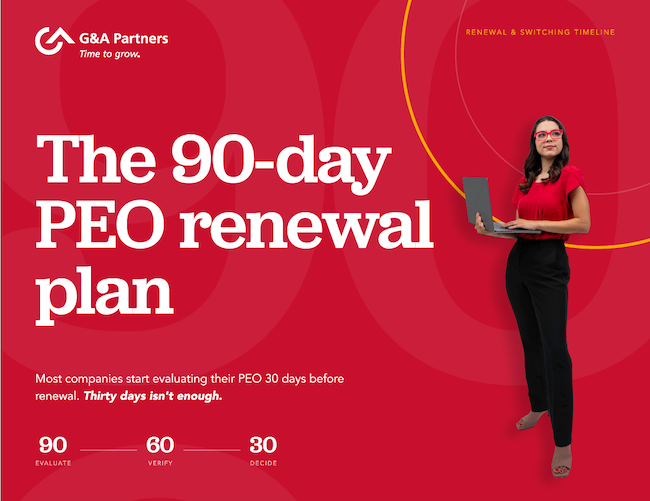
PEO Renewal & Switching Timeline
This step-by-step 90-day timeline shows you exactly when and how to evaluate, verify, and choose a PEO provider before your renewal deadline.