



- HR Speak
- HR Compliance
- Right-to-Work States: What Employers Need to Know
Right-to-Work States: What Employers Need to Know



For small and mid-sized businesses, staying on top of labor law compliance is no easy task — especially when rules vary by state. Right-to-work laws are some of the most complex. While these laws focus on union membership and dues, they can directly affect employer compliance, HR policies, and workforce management.
For businesses operating across multiple states, knowing which locations follow right-to-work laws — and how those laws differ from non-right-to-work states — is essential. And for these organizations, keeping policies aligned with evolving labor laws can require ongoing monitoring and coordination across locations.
This article explains what right-to-work laws mean, how they vary by state, and what employers need to consider to remain compliant as their workforce grows or becomes more distributed.
Understanding Right-to-Work Laws in Today’s Labor Environment
Right-to-work laws continue to play an important role in today’s labor environment, even as workplace expectations and union activity evolve. At their core, these laws determine whether employees can be required to join a union or pay union dues as a condition of employment. As an employer, that distinction affects how you structure policies, communicate with employees, and engage with labor organizations.
These laws are especially relevant if your organization has employees in more than one state. Differences between right-to-work and non-right-to-work states can complicate hiring practices, onboarding materials, and manager training. As union organizing efforts increase across industries, you must also ensure your approach remains compliant regardless of location.
Inconsistent policies, often caused by unfamiliarity with employer right-to-work requirements across states, are a common source of risk for multistate employer labor law compliance. Without clear oversight, even well-intentioned policies can be applied inconsistently across locations, increasing the risk of compliance gaps.
What Does “Right-to-Work” Mean?
In simple terms, right-to-work laws prohibit employers and unions from requiring employees to join a union or pay union dues as a condition of employment. Employees may still choose to join a union, but participation must be voluntary.
It’s important, however, to clarify a few common misconceptions. Right-to-work does not guarantee employment, nor does it eliminate unions or collective bargaining. Instead, it addresses state-by-state union membership requirements, ensuring that employees cannot be terminated solely for choosing not to join or financially support a union.
A frequent question employers ask is whether employees can be required to join a union. In right-to-work states, the answer is no. In states without right-to-work laws, union membership or payment of union fees may be required under certain collective bargaining agreements. Even in right-to-work states, however, employees who opt out of union membership may still be covered by union-negotiated contracts.
The Legal Framework Behind Right-to-Work Laws
Right-to-work laws exist within a broader federal labor law framework. The National Labor Relations Act (NLRA) established employees’ rights to organize and bargain collectively. In 1947, the Taft-Hartley Act amended the NLRA to allow individual states to prohibit union security agreements that require union membership or dues.
As a result, labor law compliance is largely state-specific. Federal law provides baseline protections, but states determine whether right-to-work rules apply to private-sector employees within their borders. This structure means employers must pay close attention to where their employees actually work — not just where the business is headquartered.
Public-sector employees and certain federally regulated industries, such as railroads and airlines, may follow different rules altogether. These distinctions reinforce why your employer policies must be tailored to both state law and workforce composition.
Which States Are Right-to-Work States?
Alabama |
Kentucky |
South Dakota |
Arizona |
Louisiana |
Tennessee |
Arkansas |
Mississippi |
Texas |
Florida |
Nebraska |
Utah |
Georgia |
Nevada |
Virginia |
Idaho |
North Carolina |
West Virginia |
Indiana |
North Dakota |
Wisconsin |
Iowa |
Oklahoma |
Wyoming |
Kansas |
South Carolina |
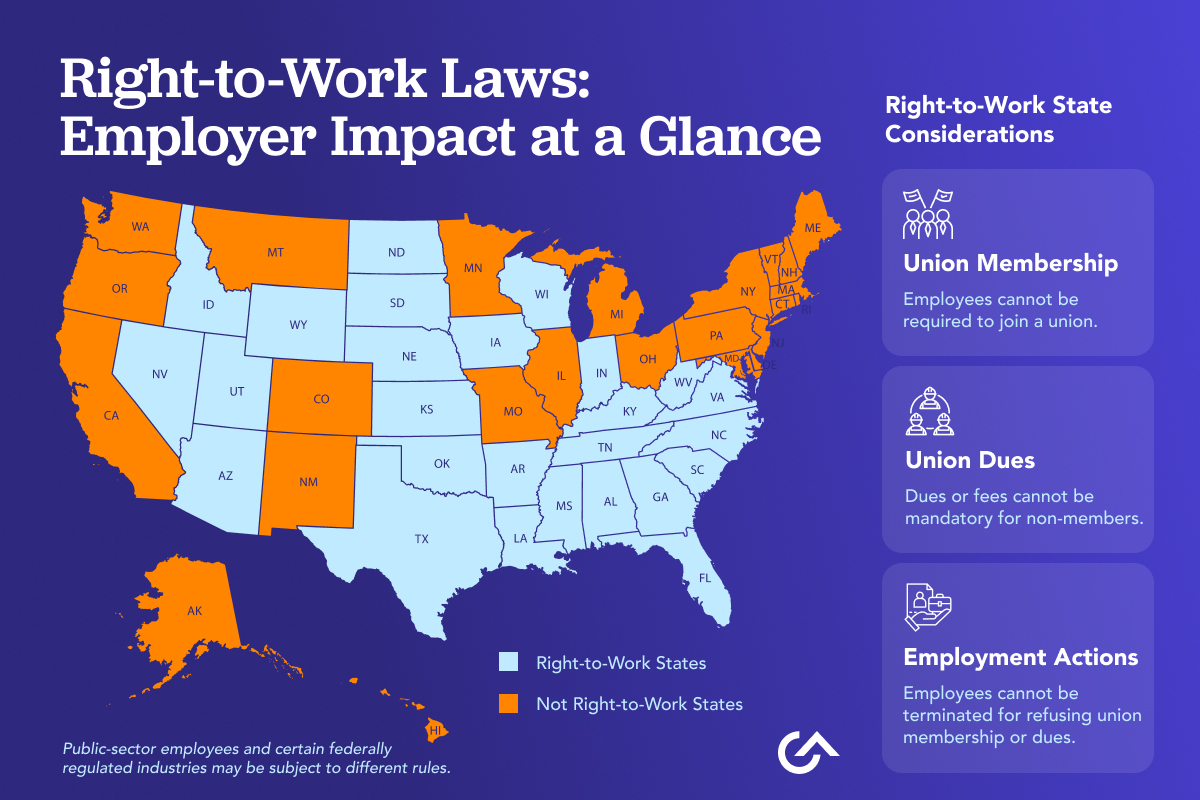
Because right-to-work laws by state can change through legislation or ballot initiatives, employers should verify requirements before making workforce decisions. Regular review is especially important if your organization manages employees across multiple jurisdictions.
Key Differences Between Right-to-Work and Non–Right-to-Work States
Understanding the distinction between right-to-work versus non-right-to-work states is critical for employer compliance. The differences affect union security agreements, HR policies, and disciplinary action procedures.
Area |
Right-to-Work States |
States Without Right-to-Work Laws |
Union membership |
Cannot be mandatory |
May be required under agreements |
Union dues |
Voluntary |
May be mandatory under agreements |
Termination protections |
Employees are protected from termination for non-membership |
Termination may occur for nonpayment of union fees |
Union security clauses |
Restricted or prohibited |
Often permitted |
Employer obligations |
Must protect employee choice |
Must align with collective bargaining terms |
HR policy complexity |
Varies by state |
Often more complex due to union rules |
If your business operates in multiple jurisdictions, these differences increase the risk of inconsistent practices. Policies that are compliant in one state may create exposure in another, making centralized oversight and clear documentation especially important. This is particularly relevant for organizations without dedicated internal HR resources to monitor state-by-state labor law changes.
Exceptions, Limitations, and Special Rules
Right-to-work laws do not apply uniformly in every situation. Public-sector employees often follow different labor rules than private-sector workers.
Following a 2018 U.S. Supreme Court decision, government employees nationwide cannot be required to pay union dues or fees as a condition of employment, regardless of whether their state has right-to-work laws for private employers. This distinction is important for organizations that employ both public- and private-sector workers, as union fee requirements and compliance obligations may differ even within the same state.
Certain federally regulated industries, including rail and airline operations, may also be exempt from state right-to-work provisions. In addition, collective bargaining agreements can introduce requirements that go beyond general state law. These agreements may override default rules and impose specific employer right-to-work requirements related to dues, representation, or dispute resolution.
Because of these nuances, right-to-work compliance for employers depends on more than state status alone. Industry, workforce type, and existing contracts all play a role.
Is There a National Right-to-Work Law?
Although federal lawmakers have proposed national right-to-work legislation in the past, no such law is currently in effect. Efforts to establish a nationwide standard have stalled, leaving enforcement to individual states.
For employers, this means state compliance remains essential. Rather than anticipating federal changes, your business is better served by monitoring state-level developments and ensuring your policies adapt as laws evolve.
How Right-to-Work Laws Affect Employers
Right-to-work laws not only influence union membership, but they also impact how your organization should draft employee handbooks, train managers, and respond to organizing activity. To eliminate noncompliance risk, hiring and onboarding materials must reflect state-specific requirements, particularly when explaining union participation or employee rights.
As an employer, you must also be cautious when communicating about unions. Even well-intentioned guidance can create risk if it is inconsistent with state law. Understanding how right-to-work laws affect employers will help you to reduce the likelihood of retaliation claims, policy disputes, or compliance violations, especially in multistate environments. And as your organization grows or expands into new states, maintaining consistency across policies and communications becomes increasingly complex — making it important to regularly review and align your HR practices across all locations.
How a PEO Supports Right-to-Work Compliance
Managing right-to-work compliance for employers requires ongoing attention. A professional employer organization (PEO) like G&A Partners can help you stay on top of it all by monitoring state labor law changes and translating those updates into practical guidance.
PEO support may include reviewing your HR policies, updating employee communications, and helping managers understand their responsibilities in different jurisdictions. By centralizing these efforts, a PEO can help reduce inconsistencies across locations and support more standardized, compliant HR practices.
If you’re a multistate employer, this level of coordination can be especially valuable. Instead of relying on fragmented processes or limited internal resources, a PEO gives you access to HR professionals who help interpret changing requirements and support alignment across your workforce.
*Important Legal Disclaimer: Nothing in this material is intended to be, nor should it be construed as, legal or financial advice. Read more.