

- HR Speak
- HR Compliance
- Employer's Liability, Workers’ Compensation, and EPLI: What Insurance Does Your Business Really Need?
Employer's Liability, Workers’ Compensation, and EPLI: What Insurance Does Your Business Really Need?



For many small and mid-sized businesses, employee-related insurance coverage is often added over time — in response to requirements, renewals, or specific situations as they arise. As a result, employers may have workers’ compensation insurance, employer’s liability insurance, or employment practices liability insurance (EPLI) in place without a clear picture of how those policies interact or where protection may fall short.
Each type of coverage serves a distinct purpose. When they aren’t aligned, however, gaps can leave businesses unintentionally exposed to employee claims, legal costs, and compliance-related risk.
This guide breaks down how workers’ compensation insurance, employer’s liability insurance, and EPLI differ, where coverage overlaps or falls short, and how to more strategically protect your business and workforce — without overbuying insurance or overlooking critical risks.
Key Takeaways
- Workers’ compensation insurance, employer’s liability insurance, and EPLI all protect employers, but from different risks
- Many SMBs assume they’re covered when they’re not, especially for employee lawsuits
- Misclassification, weak documentation, and high modification (mod) rates create major financial exposure
- Partnering with a PEO can simplify coverage, reduce risk, and improve long-term insurance outcomes
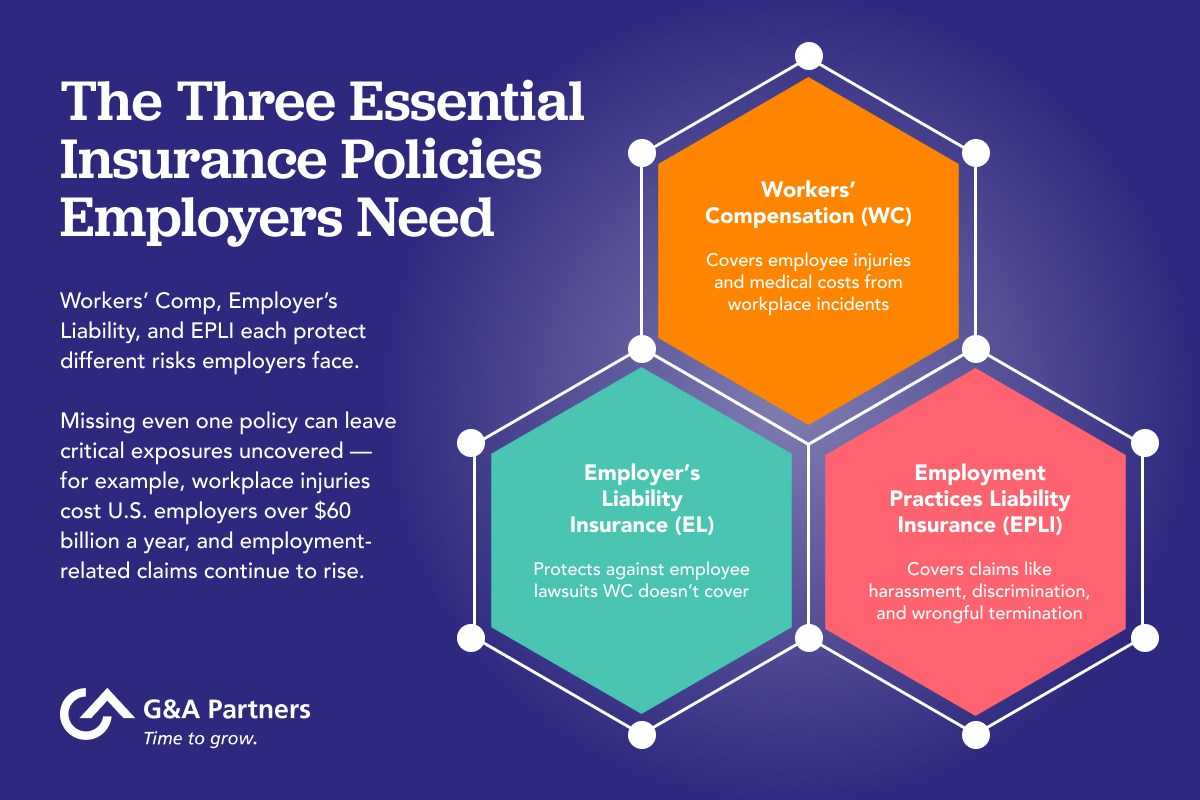
The Three Essential Insurance Protections Employers Need
Employee-related risk shows up in different ways. Workplace injuries, employment disputes, and regulatory claims all carry different implications for your business. The three insurance policies below work together to address those risks, but each one is designed to respond to a specific type of exposure. Understanding where one policy ends and another begins is key to avoiding costly coverage gaps.
Workers’ Compensation (WC) Insurance
Workers’ compensation insurance (often referred to as workers’ comp insurance) covers medical expenses and lost wages tied to work-related injuries or illnesses, and in most states, it’s legally required once you have employees.
What it covers:
- Medical treatment for work-related injuries or illnesses
- Partial wage replacement while the employee recovers
- Rehabilitation and return-to-work support
Workers’ compensation is typically a no-fault system, meaning employees receive benefits regardless of who caused the injury. In exchange, the employee usually gives up the right to sue their employer for negligence.
What it does not cover:
Workers’ compensation does not protect you from lawsuits alleging unsafe working conditions, emotional distress, or claims that fall outside traditional injury coverage. When an employee claim moves beyond medical costs and wage replacement, additional coverage may be required, which is where employer’s liability insurance comes in.
Employer’s Liability Insurance (EL)
Employer’s liability insurance helps protect businesses when employee injury claims turn into legal disputes. It is often bundled with workers’ compensation insurance, but it applies when workers’ compensation alone doesn’t provide protection.
Common examples include claims alleging:
- Employer negligence contributed to an injury
- Unsafe work conditions
- Third-party lawsuits where an injured employee sues outside the workers’ compensation system
This coverage helps pay for legal defense, settlements, or judgments related to those claims.
Employer’s liability insurance can be thought of as a legal safety net that fills the gaps left by workers’ compensation insurance, particularly when injury-related claims involve allegations beyond basic medical treatment.
Employment Practices Liability Insurance (EPLI)
EPLI addresses a very different category of risk — employment-related lawsuits that stem from management decisions, workplace conduct, or HR practices. These claims are becoming increasingly common and can affect businesses of any size.
EPLI typically covers claims related to:
- Wrongful termination
- Discrimination or harassment
- Retaliation
- Failure to promote or discipline fairly
Because these claims aren’t tied to physical injury, workers’ compensation and employer's liability won’t apply. EPLI helps cover legal defense costs and potential settlements, which can escalate quickly even if a claim lacks merit.
Common Coverage, Classification, and HR Practices That Put Employers at Risk
Many small and mid-sized businesses carry some form of employee-related insurance, but gaps often appear when coverage, classification, and documentation aren’t aligned. Below are some of the most common areas where problems arise, creating potential exposure and risk for your business:
Misclassification Issues
Misclassification occurs when a worker’s classification does not align with their actual job duties or working relationship. A common example is when a business classifies a worker as an independent contractor to reduce costs, even though their role functions like that of an employee. If that worker is injured and files a claim, and the state later determines they should have been classified as an employee, the employer may face back premiums, penalties, and claims that aren’t fully covered.
Misclassification can impact workers’ compensation, employer's liability, and employment practices liability insurance (EPLI) simultaneously, creating layered exposure across multiple policies.
Inadequate Claim Documentation
Claims don’t always fail because coverage is missing. They often fail because documentation is inconsistent or incomplete. For example, if an employee reports an injury late, the employer may have little contemporaneous documentation to reference if reporting and recordkeeping practices aren’t well established.
Without clear incident reports, aligned supervisor notes, or consistent documentation practices from the employer, insurers may question the validity of the claim. As a result, coverage can be denied, leaving the business responsible for costs that could have been avoided.
No EPLI or Extremely Low Limits
Employment practices liability insurance is one of the most overlooked coverages for SMBs. Many employers skip it altogether or carry minimal limits. But if a wrongful termination, discrimination, or harassment claim arises, legal defense costs alone can reach six figures regardless of the outcome.
Without EPLI, those costs are typically paid directly by the employer.
High Modification (Mod) Rates Driving Up Premiums
The experience modification (mod) rate reflects how your workers’ compensation claims history compares to similar businesses in your industry. A pattern of frequent or severe claims can raise that score, which directly increases workers’ compensation insurance premiums year over year—often long after the original incidents occurred.
What many employers don’t realize is that mod rates are influenced not only by injuries themselves, but by how claims are reported, managed, and resolved. Delayed reporting, limited return-to-work options, and inconsistent follow-up can all contribute to higher claim costs, even when injuries are relatively minor.
Without active claims management and safety practices in place, premiums can continue to rise based on past claims rather than current conditions, making it harder to control costs over time.
What insurance coverage does your business need?
With a clearer understanding of where risk is created and how coverage can fall short, the next step is evaluating what protections make sense for your business based on your workforce, industry, and claims history.
Rather than choosing policies in isolation, it’s helpful to step back and assess risk more holistically using the following considerations:
Step 1: Evaluate Your Workforce
Begin by taking a close look at who makes up your workforce, how they work, and where potential exposure exists. Your staffing model plays a major role in determining risk and coverage needs. Consider:
- Number of employees: Larger teams generally require higher coverage limits.
- Employee roles: Physical labor versus office-based roles affect workers’ compensation risk.
- Geography: Multistate or remote employees may trigger additional regulatory and liability requirements.
Step 2: Understand Industry Risks
Different industries carry different types and levels of exposure, and industry norms often influence both baseline coverage expectations and insurer scrutiny. For example, construction, manufacturing, healthcare, and hospitality face different exposures than professional services or technology companies.
This framework illustrates how industry risk typically maps to coverage focus:
Industry |
Key Risk Drivers |
Coverage Focus |
Construction / Manufacturing |
High physical injury risk, machinery accidents, subcontractors |
Workers’ compensation, higher EL limits, safety training |
Healthcare / Social Services |
Patient/client interactions, potential for lawsuits, HIPAA compliance |
EPLI, professional liability, workers’ compensation coverage for high-risk staff |
Retail / Hospitality |
Customer interactions, seasonal spikes, slip/fall incidents |
Workers’ compensation, EPLI for harassment or discrimination claims |
Technology / Professional Services |
Mostly desk work, remote/hybrid employees, intellectual property risks |
EPLI, lower workers’ compensation needs, cyber liability if offering tech products |
Nonprofit / Education |
Volunteers, mission-driven work, high exposure to youth/clients |
EPLI (includes volunteers), workers’ compensation for paid staff, coverage for property damage |
Step 3: Assess Your Claims History and Modification (Mod) Rate
Your experience modification (mod) rate reflects your claims history and how insurers evaluate your level of risk. A higher mod doesn’t just affect pricing — it can also influence carrier availability and underwriting decisions.
A higher mod often results in:
- Higher premiums
- Greater scrutiny from carriers
- Increased need for proactive claims and safety management
If your business has a higher claims history, you may need higher limits and additional support around claims handling and safety practices to reduce long-term exposure. This is where support from a PEO, like G&A Partners, can make a real difference for your business and your team.
Step 4: Consider Coverage Overlaps and Gaps
Once you understand your workforce and risk profile, the next step is identifying where your coverage overlaps and where gaps could leave your business exposed. This is often where misunderstandings about what each policy covers arise.
Here’s a brief overview to clarify how these coverages differ:
- Workers’ comp insurance covers medical costs and lost wages from workplace injuries, but it does not cover employee lawsuits related to harassment, discrimination, or wrongful termination. Employment practices liability insurance (EPLI) is designed to address those claims.
- Employer’s liability insurance covers certain employee injury-related lawsuits that fall outside standard workers’ compensation insurance coverage.
A PEO can bundle and manage these coverages efficiently — helping to reduce blind spots that often emerge when policies are managed independently.
Step 5: Decide on Policy Limits
When choosing policy limits, the goal is to balance adequate protection with cost, based on realistic risk exposure and potential claim severity. Limits should reflect how your business operates today and where it may be headed.
Common factors to consider include:
- Industry standards
- Mod rate
- Potential claim severity
- Workforce size and growth plans
Small, low-risk office environments may only need baseline limits, while higher-risk industries typically require higher employer's liability insurance and EPLI coverage to account for greater exposure.
When Partnering With a PEO Makes Sense
For many small and mid-sized businesses, selecting the right insurance coverage is just the first step. Keeping those policies organized, compliant, and working as intended is the ongoing challenge.
A PEO helps with coverage while also improving outcomes through:
- Proactive claims management and assistance in designing return-to-work programs that help reduce mod rates
- Workplace safety audits, guidance, and training to help prevent injuries
- Access to bundled employment practices liability insurance (EPLI) coverage that’s often unavailable or unaffordable independently
By centralizing insurance coordination, HR compliance support, and workforce expertise, a PEO can help reduce exposure and create more predictable long-term costs.
How G&A Can Help
If you’re evaluating whether your current coverage is working as intended — or where gaps may exist — a conversation with G&A Partners can help you better understand your options and next steps.