


- HR Speak
- HR Outsourcing & PEO
- Signs Your PEO Is No Longer the Right Fit
Signs Your PEO Is No Longer the Right Fit


In this article, we'll explore:
Signs Your PEO Is No Longer the Right Fit
How Do You Know If Your PEO Is No Longer the Right Fit?
Signs Your PEO May No Longer Align With Your Needs
Why Businesses Reevaluate Their PEO Needs Over Time
What to Do If You Recognize These Signs
How G&A Approaches the PEO Relationship
Frequently Asked Questions

A strong PEO relationship scales right alongside your business. When it starts to slip, you’ll likely notice rising costs without added value, slower support, technology gaps, compliance support that hasn’t kept pace as you expand, or limited benefits options. A sign or two is normal – several at once is your cue to take a closer look.
Most professional employer organization partnerships start strong and stay that way. But as your business grows, it’s worth checking whether your provider’s support, flexibility, and expertise have grown with it. Recognizing the signs early gives you time to reassess the relationship or explore a better fit.
This article covers the top signs it may be time to reevaluate your PEO, why they tend to appear as you grow, and what to do if a few signs sound familiar.
How Do You Know If Your PEO Is No Longer the Right Fit?
Many businesses partner with a PEO to access group benefits rates, streamline payroll, and get support with HR compliance. For many organizations, that value holds up over time. As your business grows, though, your HR, payroll, benefits, and compliance needs often become more complex. What worked well at one stage of growth may not always provide the same value as your workforce, locations, and business goals evolve.
That doesn’t mean anything has gone wrong. It simply means it’s worth periodically checking whether your current provider, service model, technology, and benefits still fit where your business is headed.
Signs Your PEO May No Longer Align With Your Needs
Any one of these signs can show up even in a strong partnership. Seeing several at once may signal that it’s time to reevaluate whether your provider is still the right fit.
1. Costs are rising without a matching increase in value
What you might notice: Renewals bring larger increases than you expected, or your administrative fee keeps climbing while the service level stays about the same. Bundled pricing can also make it hard to see exactly what you’re paying for.
Why it matters: Over time, this can shift the balance between what you invest and the support you receive. It’s worth understanding whether the value you’re getting still matches the cost.
Try this next: Ask your provider for an itemized breakdown of administrative fees separate from insurance and payroll taxes. A partner who is transparent about pricing makes the relationship much easier to evaluate.
2. Support feels less responsive or personal than it used to
What you might notice: The dedicated contact you started with may have been replaced by a general support line, or answers to routine questions take longer than they once did.
Why it matters: Timely, knowledgeable support becomes more valuable as your business grows and your questions get more complex. Delayed responses can cost your team valuable time or create extra work. Employees may feel it, too, as they wait longer for help with pay or benefits questions.
Try this next: Track your provider’s response times over the course of a month. If routine questions are consistently taking longer than you’d like, discuss it with your provider and see how they respond.
3. Disconnected systems are creating extra work
What you might notice: Your PEO’s platform doesn’t integrate smoothly with your other tools — performance management, accounting, or time and attendance — so your team reenters the same information in more than one place.
Why it matters: When systems don’t work together, technology can create work rather than reduce it. Disconnected systems can also affect employees through payroll delays, benefits confusion, or a less smooth day-to-day experience.
Try this next: Ask your team how smoothly your current PEO’s platform is working with other systems and where they are reentering data. That picture helps you weigh the value of a platform with more open integrations.
4. Compliance support isn’t keeping pace as you expand
What you might notice: You’re hiring in new states, and you’d like more proactive guidance on multistate registrations, remote-work considerations, or state payroll taxes than you’re currently receiving.
Why it matters: As your footprint grows, employment compliance gets more complex. A partner who offers timely, knowledgeable guidance helps you navigate new requirements with greater confidence.
Try this next: Ask your provider how it supports businesses expanding into new states and whether they support HR compliance in all 50 states. Clear, confident guidance is a good sign.
5. You’re seeking more competitive benefits to attract top talent
What you might notice: You’d like to offer specific benefits — certain medical plans, retirement options, or mental-health support, for example — that fall outside your provider’s standard options.
Why it matters: Benefits play a major role in attracting and retaining talent. If the benefits you’re currently offering no longer meet the needs of your growing workforce, it can lead to higher employee turnover or difficulty attracting top talent.
Try this next: Survey your team to determine what’s missing in your current benefits offerings, such as broad provider availability, ancillary options like dental and vision, or diverse plan options. Then ask your provider for solutions that can fill those needs.
6. You’re seeking more from your HR technology platform
What you might notice: Pulling custom reports requires your provider’s help, and reviewing employee performance or tracking required trainings requires too many manual steps.
Why it matters: Your HR technology should scale seamlessly with your business. Systems that may have seemed unnecessary at 10-15 employees can be essential to employee development, engagement, and retention at 50 or 75 employees.
Try this next: Ask your provider whether it offers additional HR technology platforms and whether you can choose the specific systems your business needs. A demo can help you determine if these systems will fit your needs.
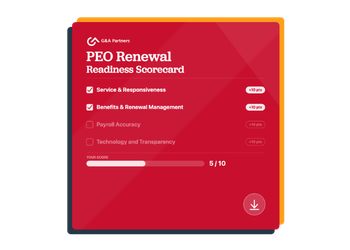
Recognize a few of these signs?
Our PEO Renewal Readiness Scorecard gives you a clear, structured way to evaluate your current provider before renewal, so you have time to compare other options before you’re locked into a renewal.
Why Businesses Reevaluate Their PEO Needs Over Time
Maybe you just hired your 50th employee or opened an office in a new state. Or your team is spending more time untangling payroll mistakes than growing your business. Moments like these are often what prompt companies to take a second look at their current PEO provider. When we talk with businesses that are exploring a change, a few themes tend to come up again and again:
Flexibility and customization. As your HR needs change, you may want the ability to pay only for the services you actually use, carve out specific benefits or workers’ compensation coverage, or update policies quickly as you add employees in new states. Many PEO relationships are collaborative, so this is often a conversation about fit and customization rather than a question of control.
The return on your investment. Beyond the invoice you receive each pay period, it’s worth considering the time your team spends navigating disconnected systems, chasing down reports, or filling gaps in service. That time is a cost, too — time that could go toward leading your people and focusing on work that grows your business. Weighing your total investment, including that time, against the results you’re getting can reveal whether it’s time to explore other PEO providers.
Employee experience and culture. As you invest in your culture, you want every employee touchpoint — onboarding, benefits enrollment, day-to-day HR support — to feel like a natural extension of your business. The right PEO partner strengthens that experience with responsive support, clear communication, and guidance that reflects how your company actually works.
What to Do If You Recognize These Signs
Spotting one or two signs doesn’t mean you have to act today — but it does make a structured look worthwhile before your next renewal. A simple path to consider:
- Take stock. Note where things feel harder than they should — response times, recurring issues, or duplicate data entry — over a 30-day period, so you’re working from a clear picture rather than a single frustrating moment.
- Understand the value. Total your annual administrative fees and weigh them against the support and results you’re actually receiving.
- Explore your options. A different PEO, an administrative services organization (ASO), or another service model may be a better fit. A conversation with a provider can help you compare what’s available.
- Plan any transition thoughtfully. If you decide to make a change, our PEO switching guide walks through how to change PEO providers while keeping payroll and benefits on track.
How G&A Approaches the PEO Relationship
Several of these signs point to the same underlying issue — whether your partner stays personal and responsive as your business grows. That’s the experience G&A is built around.
At G&A, every client works with a dedicated team, which is one reason G&A answers 88% of service calls within 20 seconds, maintains an 87% client retention rate, and earns marks from 97% of clients who say it meets or exceeds their expectations.
If you’re looking for a provider that stays close as your needs evolve, that’s exactly the kind of relationship G&A is designed to provide.
Frequently Asked Questions
What are the signs it may be time to reevaluate your PEO?
Common signs include fees rising without a matching increase in value, support that is less responsive or less personal, disconnected technology that creates extra work, compliance guidance that isn’t keeping pace as you expand into new states, and benefits options that feel limited for the talent you’re competing for. Any of these signs can appear in a healthy relationship, but several together may be worth a closer look.
How do you know if your PEO is keeping up with your business?
A helpful question is whether your provider’s support, technology, and benefits are keeping pace with your growth — such as your expansion into new states or your need for more customized benefits and reporting. If your team is taking on more of the work while your needs go unmet, it may be worth reassessing whether the current model still fits.
At what size do businesses tend to reassess their PEO?
There’s no universal number. Rather than headcount alone, the more useful trigger is your own sense of fit and value. Consider whether the support, flexibility, and expertise you’re receiving still align with your business’s needs as it grows.
Is switching PEOs the right move, or should you bring HR in-house?
It depends on what’s driving the reassessment. If the issue is a particular provider’s service, the right PEO often addresses it. If you’re seeking full flexibility and have the scale to support an internal team, an in-house HR model, an ASO, or HR technology option may be worth exploring. Quantifying your costs and listing your must-haves helps clarify the choice.
What should you consider before changing PEO providers?
A key consideration when switching PEOs is minimizing disruptions to your employees. Incomplete employee data, rushed implementation timelines, or insufficient payroll testing before the go-live date can lead to payroll and benefits disruptions.
Timing is important, too. A January 1 transition, which allows for wage bases to reset, is the cleanest option. A mid-year transition based on your PEO or benefits renewals is also possible with careful planning. An IRS-certified CPEO may carry over FICA and FUTA wage bases instead of restarting mid-year, which helps reduce duplicate payroll taxes.
*Important Legal Disclaimer: Nothing in this material is intended to be, nor should it be construed as, legal or financial advice. Read more.