


- HR Speak
- HR Outsourcing & PEO
- PEO Switching Guide: How to Change PEO Providers Without Disrupting Payroll
PEO Switching Guide: How to Change PEO Providers Without Disrupting Payroll


In this article, we'll explore:
PEO Switching Guide: How to Change PEO Providers Without Disrupting Payroll
When Should You Consider Switching PEO Providers?
How Long Does It Take to Switch PEO Providers?
When Is the Best Time to Switch?
The 6-Step PEO Switching Process
How Can We Keep Payroll and Benefits Uninterrupted During a PEO Transition?
Why Does CPEO Status Matter When Switching PEO Providers?
How G&A Makes Switching Painless
Frequently Asked Questions

Switching PEO providers is a structured process that most businesses can complete without disrupting payroll, employee benefits, or day-to-day operations. While the transition typically takes two to four months, the exact timeline depends on factors such as your workforce size, payroll complexity, benefits structure, and implementation planning.
Businesses often switch PEO providers because their needs have evolved. As your organization grows, you may be looking for more responsive service, more advanced and integrated HR technology, expert compliance guidance, better employee benefits, or a provider that's better equipped to support your long-term goals.
The key to a successful transition is preparation and choosing a provider with a proven, supportive implementation process. With the right planning and guidance, changing PEOs can be a much more straightforward experience than you may expect.
This guide explains when it may be time to switch PEO providers, how long the process typically takes, when to make the transition, and the practical steps that help keep payroll, benefits, and employees on track throughout the change.
When Should You Consider Switching PEO Providers?
You should consider switching PEO providers when your current partnership no longer aligns with your organization’s needs, goals, or plans for growth. While every business has different priorities, most begin evaluating new providers when they need better service, more advanced technology, broader HR expertise, or additional support as their workforce evolves.
Here are some common signs it may be time to explore other options:
- Support is slower or less helpful than it used to be. As your business grows, timely, knowledgeable guidance becomes increasingly valuable. If you’re spending more time following up or waiting for answers, it may be worth evaluating whether your provider's service model still meets your expectations.
- Your business has outgrown the provider. Growth often brings new HR, payroll, compliance, and workforce management needs. You may benefit from more robust HR technology, multistate expertise, or strategic HR guidance than your current provider is set up to deliver.
- Payroll mistakes keep showing up. Accurate payroll builds employee trust and helps reduce administrative load. If recurring payroll issues are creating unnecessary risk and extra work for your team, a more reliable PEO provider can better support your organization.
- The technology is holding you back. Outdated systems, limited reporting, or tools that don’t integrate with your workflows can slow down operations. As your workforce expands, modern HR technology, reporting capabilities, and system integrations become increasingly important for improving efficiency and enabling more timely, informed business decisions.
- Reactive compliance guidance is putting your organization at risk. Managing employment compliance becomes more complex as your organization grows, hires in new locations, or adapts to changing regulations. If your PEO isn’t effectively guiding you through evolving compliance expectations, that’s a red flag. A more proactive PEO can help you navigate those changes with confidence.
- The relationship no longer feels like a partnership. Many businesses choose a PEO for ongoing support, expertise, and strategic guidance. If the relationship with your current provider has become primarily transactional, it may be time to look for a PEO that takes a more collaborative approach.
For many small and mid-sized businesses, these needs become more apparent during periods of growth. According to NAPEO's 2024 research, companies that use a PEO grow more than twice as fast as similar businesses that don’t. As organizations evolve, it's important that their PEO evolves with them — providing the technology, expertise, and support needed to help sustain that momentum.
If your current provider no longer aligns with your organization's goals or growth, it may be time to explore a partnership that's better suited for where your business is headed.
How Long Does It Take to Switch PEO Providers?
Most businesses can complete a PEO transition in two to four months. The exact timeline depends on factors such as your workforce size, operating locations, payroll complexity, employee benefits structure, technology integrations, and how quickly you move through each stage of the process. While every implementation is different, most transitions follow the same four phases.
For many small and mid-sized businesses, the process typically looks like:
Phase |
Typical Timeframe |
Key Activities |
Evaluate and choose your new PEO |
Weeks 1-4 |
|
Plan the transition |
Weeks 4-5 |
|
Set up the system and begin onboarding |
Weeks 6-10 |
|
Launch first payroll and shift to ongoing support |
Weeks 11-13 |
|
The evaluation phase alone can take several weeks, particularly if multiple stakeholders are involved in selecting a new provider. Organizations with multistate teams, complex payroll structures, or extensive benefits offerings may need additional time. Businesses with straightforward payroll processes and well-organized employee records often move through implementation more quickly.
While many employers naturally want to move quickly, a successful transition is built on thoughtful planning rather than speed. Giving the implementation team enough time to validate data, configure systems, and prepare your employees for the process and provider changes helps keep payroll, benefits, and day-to-day operations running smoothly from day one.
But planning ahead isn't just about preparing your systems and employees — it also means choosing the right time to make the transition.
When Is the Best Time to Switch?
For many employers, January 1 is a good time to switch PEO providers because annual payroll tax wage bases reset at the start of the year. However, businesses can also make a successful mid-year transition by planning ahead — particularly when working with an IRS-certified professional employer organization (CPEO). The best timing ultimately depends on your contract terms, payroll schedule, benefits renewal, and broader business priorities.
Tax Considerations When Switching PEO Providers
As noted above, January 1 is often the preferred transition date because it allows your new PEO to begin the year with fresh payroll tax calculations for Social Security, Medicare, and federal unemployment (FUTA) wage bases. Starting at the beginning of the calendar year also eliminates the need to transfer partial-year payroll tax data from one provide to another.
That said, a mid-year switch can be a practical option as well. However, PEOs typically file employment taxes under their own federal employer identification number (FEIN), moving to a new provider during the year can require additional payroll tax coordination.
This is where an IRS-certified professional employer organization (CPEO) can make a difference. Under IRS rules, a CPEO may be able to treat your business as a “successor employer” during a mid-year transition. This means the new PEO can continue certain payroll tax wage-base calculations instead of restarting them, which helps avoid duplicate taxes or reporting complications.
Because every business’s tax situation is different, it’s always a good idea to review your transition plans with your provider and tax advisor before finalizing a go-live date.
Aligning Your PEO Transition with Benefits and Business Planning
Payroll taxes are only one part of the decision. Many employers also choose to align their PEO transition with their benefits renewal period, since employees already expect benefits communications and enrollment activities during that time. Coordinating these milestones can help simplify communication and reduce administrative complexity.
Before selecting a transition date, consider:
- Your current PEO’s notice requirements and renewal date
- Upcoming benefits renewal periods
- Payroll tax and reporting considerations
- Major business initiatives or seasonal workload cycles
- Internal bandwidth for implementation
- Whether your new provider is a CPEO
If your timing is limited — due to contract terms or other business priorities — a structured plan and a strong implementation team can help you successfully navigate those constraints. What matters most is planning, configuring systems, communicating with employees, and testing payroll before you go live with your new PEO.

The 6-Step PEO Switching Process
Most successful PEO transitions follow a predictable process. While every implementation is unique, your new PEO should guide you through each step, clearly outlining responsibilities, timelines, and expectations. Your role is typically to provide information, make decisions, and communicate with employees at key points — not to manage the transition alone.
Here’s what the PEO switching process typically looks like:
Step 1: Review Your Current PEO Agreement and Transition Requirements
Before evaluating new providers, review your current PEO agreement so you understand the terms and transition requirements that could affect your move. This helps you avoid surprises and ensures you’re planning around the right timeline.
Pay close attention to:
- Notice requirements (often 30 days, but this varies)
- Contract renewal dates
- Termination provisions
- Any obligations tied to payroll, benefits, or taxes
This is also when you should identify anything that may require extra planning, such as multistate payroll, complex payroll structures, or benefits plans that will be renewing soon. Knowing these details early helps you set realistic timelines and prepare for a smooth transition.
Step 2: Define What You Need From a New PEO Partner
Before comparing providers, map out what you want your next PEO partner to deliver. This helps you evaluate providers based on your organization's current needs and long-term goals — not just what’s included in a proposal.
Common priorities include:
- Stronger service and support
- Better HR or payroll technology
- Improved benefits options
- More proactive compliance guidance
- Support for multistate or fast-growing teams
As you evaluate providers, consider questions such as:
- Does the service model align with our expectations?
- Will the technology support our future needs?
- How does the implementation process work?
- What level of support is available after onboarding?
- How does the provider support growing or multistate employers?
A transition is an opportunity to fix existing pain points and choose a partner that can support your business as it evolves.
Step 3: Gather and Transfer Employee and Payroll Data
Once you’ve selected your new provider, implementation begins. The first major step is data collection.
Your implementation team will guide you through gathering information such as:
- Employee records
- Payroll history and year-to-date totals
- Tax information
- Benefits elections
- Time and attendance data
- Company policies and organizational details
Your new PEO will handle the heavy lifting — configuring systems, mapping data, and preparing your setup — but your team also plays an important role in gathering data and reviewing information for accuracy.
Accurate information helps ensure payroll processing, tax reporting, benefits administration, and year-end filings are set up correctly from the start.
Step 4: Configure Benefits and Prepare Employee Communications
Benefits planning and employee communication typically happen together during implementation.
During this phase, you’ll work with your new provider to:
- Review available benefits plans
- Finalized your selections
- Set enrollment dates
- Prepare employee communication materials
Clear, timely communication helps employees understand what to expect throughout the transition and where to go if they need assistance. It also proactively answers common questions, such as:
- Will my pay schedule change?
- Will my benefits change?
- Will I need to enroll again?
- How do I access the new system?
- Who should I contact if I need help?
Step 5: Validate Payroll and System Configuration
Before processing the first payroll with your new PEO, your implementation team will conduct thorough reviews to verify that systems, payroll, and benefits have been configured correctly.
This may include:
- Payroll audits
- Tax setup reviews
- Benefits deduction validation
- Employee data verification
- System testing
- Parallel payroll comparisons (when needed)
Not every employer requires the same level of testing. Larger organizations, multistate employers, and businesses with more complex payroll structures often need additional validation.
The goal is to identify and resolve issues before employees receive their first paycheck through the new system.
Step 6: Go Live with Your New PEO Relationship
Once implementation is complete, your organization transitions from onboarding to an ongoing service relationship with your new PEO.
This phase includes:
- Employees accessing their new systems
- Payroll processing through the new platform
- Benefits going live according to the implementation schedule
After the first payroll, your implementation team will typically stay involved for a short period to answer questions, refine processes, and ensure everything is running smoothly. Responsibility will then shift to your long-term service team — the group that will support your organization moving forward.
How Can We Keep Payroll and Benefits Uninterrupted During a PEO Transition?
Keeping payroll and benefits running smoothly is one of the biggest priorities during a PEO transition. A well-established PEO with a structured implementation process and a strong commitment to client support can help make the transition as seamless as possible — minimizing disruption to employee pay, benefits coverage, or day-to-day operations.
The following practices play an important role in ensuring a successful transition:
Accurate Employee and Payroll Data
A smooth transition starts with complete and accurate information. Your new PEO should guide you through gathering and reviewing the employee and payroll data needed to configure payroll, benefits, tax settings, and other HR systems correctly from the start.
This will include, but is not limited to:
- Employee records
- Payroll history and year-to-date totals
- Tax setup details
- Benefits elections
Reviewing this information early will help identify discrepancies before they move into the new system, helping ensure accurate tax withholding, payroll processing, benefits administration, and year-end reporting.
Thorough Payroll Validation Before Go-Live
Before processing your first payroll, your new PEO should validate that payroll, taxes, and deductions have been configured correctly. Taking time to verify these details before employees are paid through the new system helps reduce the risk of errors and ensure accurate paychecks from the first payroll onward.
During validation, your implementation team will help you confirm that:
- Pay cycles line up with your current schedule, so employees don’t experience delays or unexpected timing changes.
- Earnings and deductions are calculated correctly, including overtime, bonuses, commissions, and benefits.
- Taxes are set up correctly for every employee, especially if you operate in multiple states or local jurisdictions.
- Employee data is complete and consistent, because even small discrepancies can cause payroll errors.
- The results match what you’ve run historically, often through a side-by-side comparison with a recent payroll.
Careful Benefits Planning
Benefits transitions require coordination between your business, your new PEO, insurance carriers, and your employees. A strong implementation team will help manage that coordination — working with carriers, establishing enrollment timelines, confirming coverage effective dates, and preparing employee communications. Your role is to make key decisions and review important information, while your PEO helps guide the process from start to finish.
This collaborative approach helps minimize confusion and reduce the risk of gaps in coverage during the transition period.
Consistent Employee Communication
Employees feel more comfortable with a PEO transition when they are informed and supported throughout the process — that means they receive clear and timely information about what's changing, what isn't, where to go with questions, and how to access and use systems. An experienced PEO with a structured implementation process will help coordinate employee communications, provide supporting materials, and guide your organization through each stage of the transition.
Why Does CPEO Status Matter When Switching PEO Providers?
If you're evaluating new PEO providers, one important question to ask is whether they are a Certified Professional Employer Organization (CPEO).
A CPEO is a PEO that has been certified by the IRS after meeting strict financial, reporting, and compliance requirements. This certification provides specific federal employment tax advantages that can make a transition easier to manage — especially if the switch happens mid-year.
What Makes CPEOs Different
For employers making a mid-year PEO transition, CPEO status can provide several important payroll tax advantages.
For example, a CPEO can:
- Carry over your FICA and FUTA wage bases
- Help prevent duplicate taxation
- Assume responsibility for federal employment tax filings
For many employers, this means avoiding duplicate Social Security and FUTA taxes that can sometimes occur when moving between non-certified PEOs during the same calendar year.
G&A’s CPEO Certification
G&A Partners is an IRS-certified CPEO, ESAC accredited, and licensed in all 50 states. This means your wage bases remain protected even during a mid-year transition — and you gain added assurance that your provider meets established IRS standards.
How G&A Makes Switching Painless
Switching PEO providers can feel like a big transition, but the right implementation partner can make the process much more manageable. At G&A Partners, we guide you through every stage of the process — from planning and system setup to payroll, benefits, and employee communications — so you always know what to expect and what comes next.
For more than 30 years, G&A Partners has helped small and mid-sized businesses navigate workforce growth, operational changes, and PEO transitions with a service model built around responsive support and personalized guidance.
Our commitment to service is reflected in the results:
- 87% client retention rate
- 88% of service calls answered within 20 seconds
- 97% of clients say G&A meets or exceeds their expectations
These outcomes reflect an implementation process designed to make your transition as smooth as possible while providing the support you need long after onboarding is complete.
When you switch to G&A, you receive:
- Dedicated implementation leadership
- Expert payroll and HR system configuration
- Benefits planning and enrollment support
- Employee training and communication resources
- Payroll validation and go-live preparation
- Ongoing service after implementation
Our goal is simple: to make your transition as smooth as possible while setting the foundation for a strong, long-term partnership.
Frequently Asked Questions
Is switching PEO providers difficult?
Switching PEO providers is often easier than employers expect when they work with a provider that has a well-organized implementation process and a strong commitment to client support. Your new PEO should guide you through each step, coordinate the transition, and clearly communicate what's needed from your team along the way. In most cases, your role is to provide information, review key decisions, and communicate with employees — not manage the implementation yourself.
How do you switch PEO providers without disrupting payroll and benefits?
Payroll and benefits disruptions are typically caused by incomplete employee data, rushed implementation timelines, or insufficient testing before the first live payroll — not by the act of switching PEOs itself.
Working with a PEO provider that validates payroll, coordinates benefits, and allows enough time for implementation helps minimize these risks and keeps the transition on track.
Can I switch PEO providers mid-year?
Yes. While many employers choose to switch PEO providers on January 1, a mid-year transition can also be successful with the right planning. If your new provider is an IRS-certified CPEO, your FICA and FUTA wage bases may carry over instead of restarting, helping reduce duplicate payroll taxes. Many employers also align a mid-year transition with their benefits renewal period to simplify employee enrollment and communications.
Be sure to discuss timing, CPEO status, and payroll tax considerations with prospective providers early in the evaluation process.
How much notice do I need to give my current PEO?
Notice requirements vary by provider, though 30 days is common. Review your agreement carefully for notice periods, auto-renewal terms, renewal dates, and termination provisions. Understanding these details early helps you plan a more realistic transition timeline.
What is the best time of year to change PEOs?
January 1 is the cleanest option because wage bases reset. A benefits renewal date — often July 1 for mid-year plan years — is another natural transition point. If those dates don’t work, an IRS-certified CPEO can help simplify tax considerations associated with a mid-year switch.
Will my employees need to re-enroll in benefits?
It depends on the timing of the transition, the plans you select, and carrier requirements. During implementation, your new provider will explain enrollment steps and help coordinate employee communications.
What should I ask a prospective PEO before switching?
Before deciding whether to switch PEOs, consider asking:
- What does your implementation process look like?
- Who will you support us during the transition?
- How long does onboarding typically take?
- What responsibilities will our team have during implementation?
- How do you support employee communications and training?
- What ongoing support is available after onboarding?
- Do you have CPEO status?
These answers can help you compare providers beyond pricing and better understand what the transition experience will look like.
Is your PEO working for you?
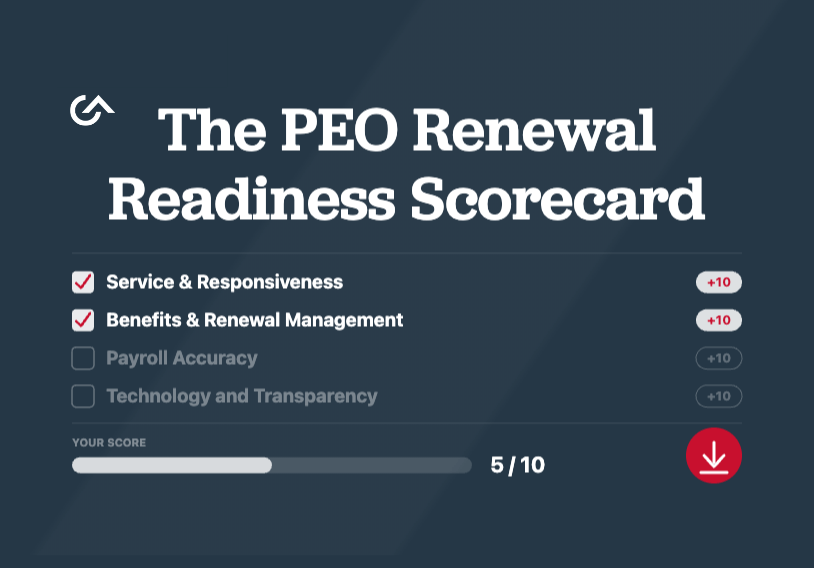
Our PEO Renewal Readiness Scorecard gives you a structured way to evaluate your current provider across four categories: service, benefits, compliance, and pricing. Download it now.