



- HR Speak
- HR Outsourcing & PEO
- How to Manage HR During Rapid Growth
How to Manage HR During Rapid Growth



The most effective way to manage HR during rapid growth is to get the right support in place before growth outpaces your systems — and to build a solid HR foundation at each stage along the way. That means documented policies, a structured onboarding process, benefits your team values, and an HR partner who can help you navigate compliance as your headcount and geography expand.
Growing a business is exciting — and exhausting. When demand picks up and your team starts expanding, most leaders feel a familiar mix of momentum and overwhelm. You're hiring faster than you can onboard. HR questions are landing on your desk that you're not sure how to answer. Expansion into a new state is on the horizon, and you've realized payroll is about to get more complicated.
Here's the good news: You don't have to figure all of this out alone.
The right HR support doesn't just help you manage the paperwork that comes with growth — it can help remove some of the biggest obstacles that hinder growth. Think less time spent navigating complex compliance obligations and more time focused on the things only you can do, like leading your team, serving your customers, and building the business you set out to build.
This article walks through the HR challenges that tend to surface at each stage of growth and how having the right HR partner can help you move through each one with confidence.
Why does HR get harder as you grow?
HR complexity doesn't grow at the same pace as your headcount — it tends to grow faster. What worked for a team of 10 starts to break down well before you reach 50. The informal systems and the handshake policies may serve you well early on, but growth exposes every gap.
Part of what makes this hard is that this complexity sneaks up on you. Maybe your “HR department” right now is you, your office manager, and a shared drive full of policy drafts. That’s manageable at 12 employees who all know each other. At 40 or 50, it means new hires get different answers from different managers, benefits questions go unanswered, and small process gaps turn into real compliance risk.
This is a normal part of scaling a business. The companies that handle it well aren’t necessarily the ones with the most resources. They’re the ones that recognize the inflection points early and get the right support in place before HR becomes a bottleneck.
Around 25 employees: When personal starts to feel impersonal
Around the 25-employee mark, something shifts. Managing every employee the same way you did when you had a small team gets harder as your headcount grows. It's a clear indication that it's time to build more structure into how you support your people.
At this stage, the most pressing challenge is often consistency. Who gets what flexibility? How are raises determined? What happens when two employees have the same conflict, but they are handled differently by different managers? Without documented policies and clear processes, you're making HR decisions on the fly, which creates risk.
This is also when onboarding starts to matter. New hires need an introduction to how things work, what's expected, and where they fit. A strong onboarding program accelerates time-to-productivity for new hires and supports long-term retention.
What this looks like for an operations leader: If you're overseeing multiple departments or locations, inconsistent HR processes across teams can quickly become an issue. Policies are patched together from memory, and compensation decisions feel uneven.
Where HR support helps at this stage: A good HR partner can help you build the foundational infrastructure you need — job descriptions, an employee handbook, a straightforward onboarding process, and documented policies that give you something to point to. It's not about bureaucracy. It's about giving your growing team a fair, consistent experience.
Around 50 employees: When risk increases
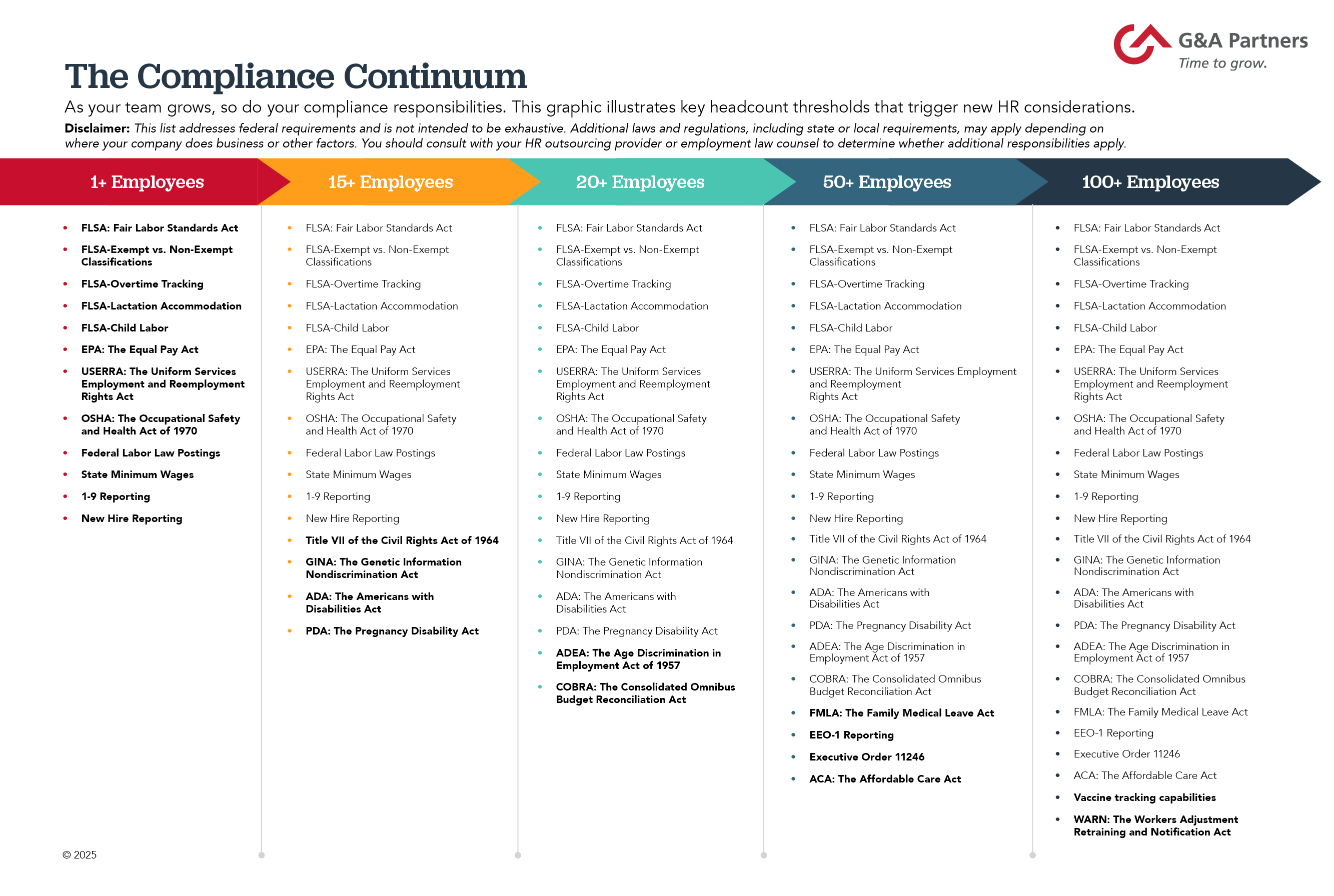
This is the milestone that often catches businesses off guard. Reaching 50 employees doesn't just feel different — legally, it is different.
Certain employment laws and benefits requirements may begin to apply for the first time as you approach 50 employees, including obligations under the Affordable Care Act (ACA) and the Family and Medical Leave Act (FMLA). That’s a meaningful jump in what your business is responsible for tracking.
Having expert guidance in place to help you understand these new requirements and what they mean for your specific situation can make navigating them more manageable.
What this looks like for a multistate operation: If you've expanded into a second or third state, your compliance picture gets significantly more complex. State leave laws, minimum wage requirements, and local ordinances vary widely — and what's required in Texas, for example, may be entirely different from what's required in California or New York. Keeping up with all of it while running a business can feel overwhelming.
Where HR support helps at this stage: This is often when businesses realize that a DIY approach to HR isn't sustainable. An experienced HR partner can help you understand which requirements apply to your business, assist you with developing policies that reflect those requirements, and help ensure your benefits offerings are competitive and compliant.
Around 75 employees: When management becomes its own HR challenge
By the time you reach 75 employees, you almost certainly have a layer of middle management in place. And that's where a new set of HR challenges tends to emerge. First-time managers often lack the training needed to effectively handle employee conflict, difficult conversations, or delegation.
Performance management also gets more complicated at 75 employees. Informal feedback isn't enough to retain your best people or address underperformance before it becomes a problem. You need a system with clear expectations, regular check-ins, documented reviews, and a consistent process for handling issues as they arise.
Compensation is another pressure point. As your team grows, employees start comparing notes. Having a transparent approach to pay helps create clarity and consistency around compensation decisions.
What this looks like in practice: Gallup research shows that when one team is more engaged than another, the manager is usually the reason why. When high-performing employees are promoted into leadership roles without guidance on managing people, the effects can appear quickly, ranging from disengaged teams to increased turnover.
Where HR support helps at this stage: The right HR partner can assist you with building a performance management framework, supporting manager development, and establishing compensation benchmarks that make sense for your market and your size. Building a workplace with the right HR infrastructure in place helps retain good people and keeps the business moving forward.
Around 100 employees: When culture and technology must carry more weight
At 100 employees, the culture that got you here needs active maintenance or it starts to erode. What made your company a great place to work when you had 20 people doesn't sustain itself automatically at 100. It requires intention.
This is when company culture becomes an HR strategy. How are you communicating company values to new hires? How are you keeping employees connected to the mission when they're spread across three locations or two states? What does your employer brand say to the candidates you're trying to recruit?
HR technology also becomes a more pressing need at this stage. Manually tracking time off, running payroll through a patchwork of systems, or onboarding new employees with paper forms creates inefficiencies that compound quickly. The right HR technology platform can streamline all of this — and give employees the self-service tools they expect.
What this looks like for an operations leader managing multiple locations: Vendor consolidation often becomes a priority at this stage. Many growing businesses start with a payroll provider service, then add a system for benefits administration or time and attendance. Suddenly, you’re managing tech clutter that was supposed to simplify HR.
Where HR support helps at this stage: A full-service HR partner can help you align your people strategy with your business goals and implement an integrated HR technology platform to simplify and streamline processes. From conducting engagement studies to reviewing benefits packages to ensure they’re competitive, this strategic approach to HR helps ensure that your people, processes, and culture continue to support the business as it grows.
How do HR services improve business operations?
HR services improve business operations by taking the administrative and compliance weight off your plate and replacing it with expertise most growing businesses lack in-house. Here’s where that impact shows up most:
- Time. When payroll, benefits administration, compliance tracking, and employee questions are handled by an expert team, you get hours back — hours that go toward customers, strategy, and growth instead of HR administration.
- Risk reduction. Employment law is complex and always changing. An experienced HR partner can help you stay on top of requirements as your business grows and evolves — flagging potential issues before they become costly problems.
- Talent. Through a professional employer organization like G&A Partners, small and mid-sized businesses gain access to Fortune 500-caliber benefits at a price point that's typically out of reach on their own. That matters in a competitive hiring environment. Better benefits attract better candidates — and they help you keep the people you've worked hard to develop.
- Consistency. Documented processes and clear policies create a more equitable, predictable experience for your employees, which improves morale, reduces friction, and makes managers' jobs easier.
- Scalability. A good HR foundation scales with you. When the next growth phase comes — and it will — you're not starting from scratch or scrambling to keep up.
Together, these benefits help create a more resilient organization that’s better equipped to adapt, compete, and grow. In fact, the National Association of Professional Employer Organizations (NAPEO) reports that businesses grow twice as fast, have 12% lower turnover, and are 50% less likely to go out of business when they partner with a PEO.
What makes G&A different for growing businesses?
G&A Partners started as a small business, and we approach every client relationship through that lens. We've spent more than 30 years helping businesses like yours navigate the exact challenges described in this article, from the moment when HR stops being manageable on your own to the complexities of operating in multiple states with hundreds of employees.
That experience produces a team that understands the challenges of HR and the reality of running a growing business. Our clients aren’t just looking for a vendor. They’re looking for a partner who gets it.
That partnership shows up in the numbers:
- G&A answers 88% of service calls within 20 seconds.
- Our Net Promoter Score ranks us best in class within our industry.
- 97% of our clients say G&A meets or exceeds their expectations.
FAQ
How do HR services support business growth?
HR services support growth by handling the administrative, compliance, and people-management functions that become more complex — and more time-consuming — as your team expands. When an experienced HR outsourcing partner manages payroll, benefits, compliance guidance, and employee relations on your behalf, you're free to focus on what drives growth — sales, operations, customer experience, and strategy.
How do companies manage HR during rapid growth?
The most common approaches are hiring internal HR staff, outsourcing HR to a PEO, or a combination of both. For most small to mid-sized businesses in growth mode, a PEO or HR outsourcing model makes the most sense because it provides access to a full team of HR specialists without the cost or complexity of building a large internal department.
What HR challenges come with rapid business growth?
The most common include keeping up with compliance requirements as headcount and geography expand, managing benefits costs and administration, developing managers who haven't led teams before, maintaining consistent HR policies across locations, and attracting and retaining talent in a competitive market.
What is a PEO, and how does it help scaling businesses?
A PEO, or professional employer organization, enters into a co-employment relationship with your business and takes on many of the administrative responsibilities associated with having employees, such as payroll processing, benefits administration, compliance support, and HR management. For scaling businesses, a PEO provides access to enterprise-level HR infrastructure and expertise that would otherwise require a much larger internal team to replicate.
When should a growing business consider outsourcing HR?
There's no single trigger, but there are a few common signals:
- HR tasks are consistently taking time away from your core business
- You've reached or are approaching 50 employees and new compliance obligations
- You're expanding into new states and aren't sure what's required
- Your benefits package isn't competitive
- You're managing multiple HR vendors without an integrated platform
To begin evaluating your options, download our PEO Purchasing Guide. It covers what to look for, questions to ask, and what to expect from the process.
Can a PEO help with multistate HR compliance?
Yes. And for many businesses, multistate compliance is a primary reason they partner with a PEO. Employment laws vary significantly by state, and managing those differences across multiple locations requires expertise that most growing businesses may not have in-house. An HR partner like G&A can help you understand what's required in each state where your employees work and help you develop policies and practices that reflect those requirements.
*Important Legal Disclaimer: Nothing in this material is intended to be, nor should it be construed as, legal or financial advice. Read more.